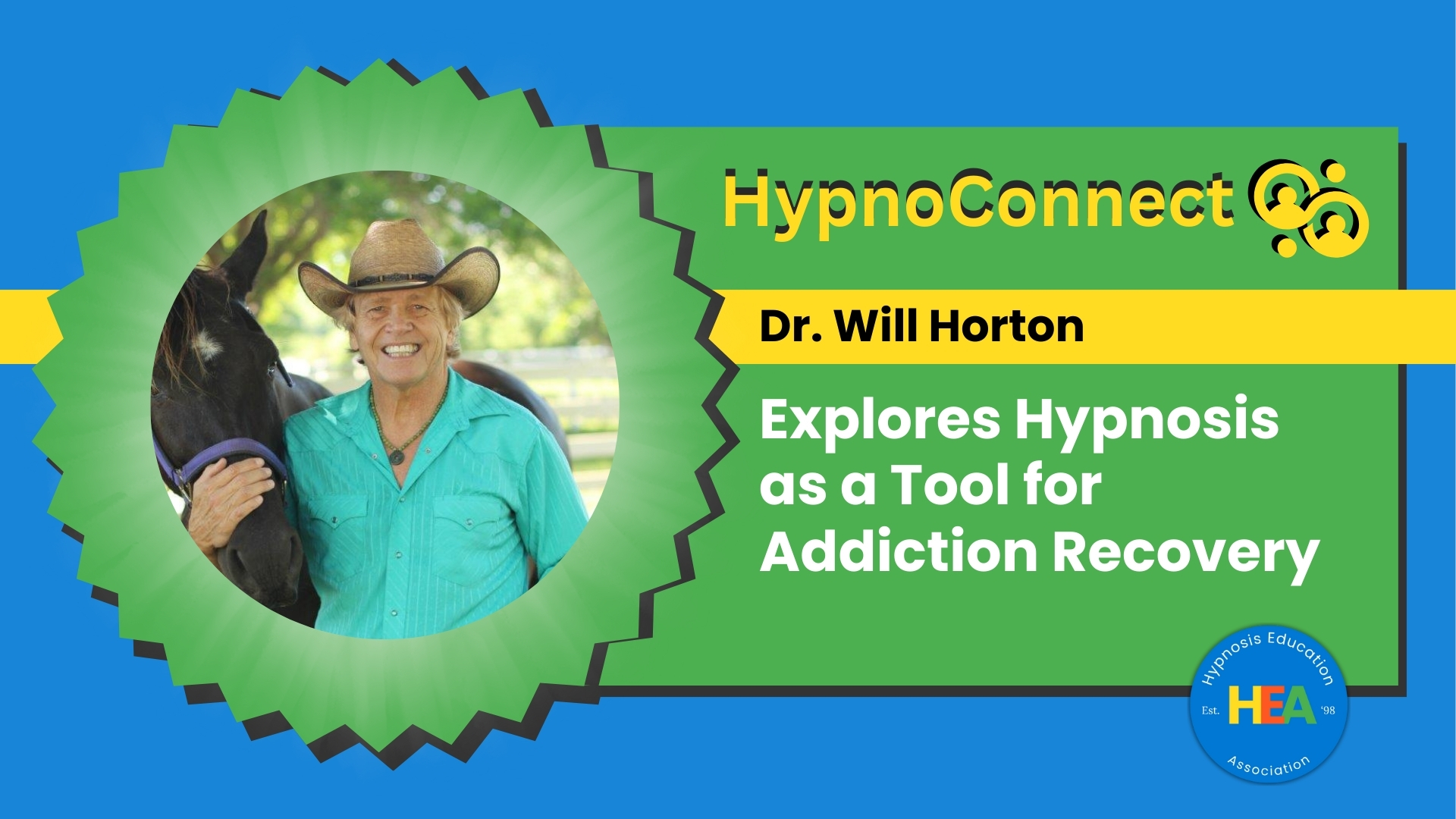
Hypnosis for Addiction Recovery (Dr. Will Horton)
In a compelling discussion hosted by the Hypnosis Education Association, Dr. Will Horton, a leading expert in hypnosis, NLP, and addiction recovery, unravels the complexities of addiction. Drawing on decades of personal and professional experience, Dr. Horton shares science-backed insights into how hypnosis can address addiction by rewiring the brain, offering genuine hope for both practitioners and those seeking recovery.
Watch the full session on YouTube:
Setting the Stage: Engaging the Mind for Learning
Dr. Will Horton kicks off by encouraging viewers to approach the session with curiosity, asking: "How can I enjoy this class? How can I use this material personally and professionally? How can I apply this in every aspect of my life?"
This open-ended questioning, he explains, activates the brain's prefrontal cortex and deeper regions, fostering autopilot learning akin to Buddhist "wise mind" practices. It is an immediate demonstration of hypnotic principles at work, before the formal content even begins.
This kind of accessible, practitioner-focused education is exactly what the HEA's monthly HypnoConnect events are built around, bringing leading voices in the field directly to working hypnosis professionals.
Understanding Addiction Through the Levels Model
Dr. Will Horton introduces his "Levels Model" to map addiction's progression, drawing a clear and important distinction between habits, abuse, and dependence. He uses cultural examples, like TV shows that glamorize drinking among cowboys and elites, to show how early beliefs about substances are formed long before a person ever takes their first drink.
The Five Levels of Addiction
Abstinence: Newborns naturally reject alcohol's taste, but media and family exposure gradually erode this aversion over time.
Experimentation: Around 90% of teens try drugs or alcohol in high school, heavily influenced by media glorification and social pressure.
Social Use: True social users may leave drinks unfinished and go weeks without drinking, showing minimal disruption to brain chemistry.
Abuse (Substance Abuse Disorder): Involves continued use despite clear negative consequences, such as self-medicating after job loss or chronic stress. Many at this stage revert to social use when life circumstances change.
Dependence (True Addiction): A neurological shift where the prefrontal cortex shuts down during cravings and the midbrain treats substances as survival needs, driven by powerful dopamine responses.
Dr. Horton also shares his own recovery journey from the 1980s, using hypnosis and NLP to overcome addiction firsthand. His personal story grounds the clinical framework in lived experience and makes this presentation unlike anything you will find in a textbook. It is the kind of raw, informed, practitioner-to-practitioner conversation that the HEA member community thrives on.
The Neuroscience of Addiction
Using MRI studies, Dr. Will Horton explains that in dependent individuals, simply thinking about a drink dims the prefrontal cortex, the part of the brain responsible for planning and rational decision-making, and activates the midbrain, the center of craving and fight-or-flight responses.
This neurological reality explains one of addiction's most haunting truths: "One is too many, and a thousand's not enough."
He also highlights that alcohol, despite receiving far less media attention than drugs like fentanyl, is responsible for the most substance-related deaths. Genetic factors compound the problem further. Slow alcohol metabolism, where the body takes two to three hours to process just one ounce, dramatically increases the risk of dependence, particularly in certain genetic groups.
Understanding this science is not just academically interesting. For hypnotherapists, it is the foundation of effective, ethical treatment. The Hypnosis Education Opportunities available through HEA regularly cover neuroscience-informed approaches like this, helping practitioners stay current and credible.
The Happy Rat Study and the Role of Hope
One of the most memorable moments of the session is Dr. Horton's reference to the "Happy Rat Study." In this research, addicted rats kept in isolated cages continued using substances compulsively. But when placed in enriched environments with peers, activities, and stimulation, they stopped.
The human parallel is striking. When Vietnam War veterans returned home, 95% quit heroin without formal treatment. The exception? Those returning to low-hope environments, areas marked by factory closures, unemployment, and social isolation.
"Recovery thrives on hope, new social networks, and retraining dopamine responses for sober fun."
Addiction raises the brain's reward threshold over time, meaning everyday life begins to feel flat and joyless without substances. The work of recovery, and the work of a skilled hypnotherapist, is to help rebuild those reward pathways so that sober life feels worth living again.
This hope-centered framework resonates deeply with the HEA's mission to advance hypnosis as a legitimate, compassionate, and evidence-informed healing tool.
Why Traditional Approaches Often Fail
Dr. Horton does not shy away from critiquing traditional interventions. Confrontational family sessions, a common staple of addiction treatment, often backfire by increasing shame rather than motivating change. Shame, as research consistently shows, is one of the most powerful triggers for relapse.
Hypnosis and NLP work differently. They address the subconscious beliefs driving addictive behavior, including deeply rooted fears like "I won't be fun without drinking" or "I don't know who I am sober." By working at the level of belief rather than behavior alone, hypnotherapy creates change that sticks.
Dr. Horton notes that many addiction cases are referred to him precisely because they fall outside the general scope of standard therapy. One client arrived intoxicated to his first appointment, a reminder that detox must sometimes precede any meaningful therapeutic work.
Practical Strategies for Hypnotists Working with Addiction
This section of Dr. Horton's presentation is a goldmine for working practitioners. His advice is direct, specific, and immediately applicable:
Specialize, do not generalize. Focusing on a niche like addiction or cancer support allows you to develop real depth and attract the right clients.
Test for sobriety before sessions. Ask clients to abstain for two days before their appointment. If they cannot, a detox referral is needed first.
Keep candy on hand. Blood sugar instability is common in early recovery and can derail sessions. A simple piece of candy can stabilize a client enough to do meaningful work.
Know your scope of practice. Hypnotherapists are not addiction counselors or medical detox specialists. Knowing when to refer is as important as knowing how to help.
Dr. Horton also introduces his own program, "The Sobriety Society: Sober is the New Sexy," which targets entrepreneurs seeking to reclaim focus and control, and counteracts the social and environmental triggers that make sobriety feel like deprivation rather than liberation.
If you are ready to deepen your own skills in areas like addiction recovery, the HEA's education resources and live community events are a strong place to start.
Genetic Insights and Treatment Barriers
Genetic predisposition testing for addiction risk is an emerging area, though it currently raises serious concerns around workplace discrimination and insurance consequences. Dr. Horton shares a personal story about a close friend whose alcoholism pattern directly reflected a genetically slow metabolism, illustrating how biology and behavior are deeply intertwined.
He also addresses the very real structural barriers that prevent people from seeking help:
Single parents who fear their children will enter foster care if they admit to addiction
Entrepreneurs in right-to-work states who fear losing their businesses or professional licenses
The isolation of residential rehab, which removes people from the very support networks they need most
Outpatient treatment in familiar environments, he argues, consistently outperforms isolated residential facilities for long-term recovery. This insight has direct implications for how hypnotherapists position and structure their services.
Community, Collaboration, and Upcoming Events
Dr. Horton closed by highlighting the power of community in sustaining both recovery and professional growth. He shared his plans to attend major upcoming events including the ACT in May and the Guild's 75th conference in both Orlando and Marlborough, Massachusetts.
The International Hypnosis Business Summit was also announced, actively seeking presenters and volunteers across areas like social media management and event coordination.
For those wanting to engage with this community now, HEA membership is available for just $55 and includes access to the full library of 2024 conference replays. It is an exceptional starting point for any hypnosis professional looking to grow.
Stay current with insights like these from every HEA session by subscribing to the Hypnotes Newsletter, your inside connection to the hypnosis community's most important conversations.
Key Takeaways
Addiction is a neurological condition, not a moral failure, and hypnosis can directly address the brain changes that drive it.
Hope and enriched social environments are among the most powerful forces in recovery.
Shame-based interventions consistently fail. Subconscious belief change is where lasting recovery begins.
Hypnotherapists should specialize, screen for sobriety, and know their referral boundaries.
Structural barriers like fear of job loss and custody concerns are real obstacles that practitioners must understand and navigate with clients.
Ready to Bring These Insights Into Your Practice?
Dr. Will Horton's session is just one example of the transformative education the Hypnosis Education Association delivers to its community every month.
Register for the next HypnoConnect event and learn live from leading experts in hypnosis and NLP
Join HEA as a member and access 2024 conference replays, monthly events, and a global professional community
Explore Hypnosis Education Opportunities to continue building your expertise in addiction recovery and beyond
Apply to speak at a future HEA event if you have expertise worth sharing with our community
For more, register for the next HypnoConnect session and become part of the conversation shaping the future of hypnosis.
Listen on the go via Podcast: https://www.podbean.com/eas/pb-3hxie-1a675a9
Frequently Asked Questions
1. Can hypnosis really help with addiction recovery?
Yes. Hypnosis works by accessing the subconscious mind to reframe the beliefs, fears, and emotional triggers that fuel addictive behavior. Unlike talk therapy, which engages the conscious mind, hypnosis can directly address the neurological patterns driving cravings. Dr. Horton's own recovery and decades of clinical work demonstrate its effectiveness. Explore HEA's education resources to learn evidence-based approaches to using hypnosis in addiction treatment.
2. What is the difference between substance abuse and true addiction?
Substance abuse involves continued use despite negative consequences, but the individual still retains some level of prefrontal cortex control. True addiction, or dependence, is a neurological shift where the midbrain takes over during cravings and treats the substance as a survival need. Many people at the abuse stage recover with life changes alone, while dependence requires more targeted intervention. Dr. Horton's Levels Model helps practitioners identify exactly where a client is in this progression.
3. Should hypnotherapists work with clients who are actively using substances?
Not without a sobriety baseline first. Dr. Horton recommends asking clients to abstain for at least two days before any session. If a client cannot maintain that, they likely need medical detox before hypnotherapy can be effective. Knowing this boundary protects both the client and the practitioner. The HEA Code of Ethics provides clear guidance on scope of practice for situations like this.
4. Why do shame-based interventions like confrontational family sessions often fail?
Shame activates the same stress and survival circuits in the brain that addiction exploits, making it one of the most reliable relapse triggers. When someone feels cornered or humiliated, the midbrain takes over and the prefrontal cortex shuts down, which is the exact neurological state that fuels addictive behavior. Hypnosis works in the opposite direction by creating safety, reducing shame, and building subconscious motivation for change. HEA's community events regularly address these clinical distinctions in depth.
5. What role does the environment play in addiction and recovery?
Environment is one of the most powerful factors in both relapse and recovery. The "Happy Rat Study" and Vietnam veteran data cited by Dr. Horton both demonstrate that people in enriched, hopeful, socially connected environments recover at dramatically higher rates. For hypnotherapists, this means helping clients build new social networks and positive routines is just as important as the session work itself. The Hypnotes Newsletter explores this and other evidence-based recovery frameworks regularly.
6. How can hypnotherapists specialize in addiction recovery?
Start by building your knowledge of addiction neuroscience, trauma-informed care, and referral pathways for detox and medical support. Dr. Horton recommends niching down rather than staying a generalist, as specialization builds credibility and attracts the right clients. Attending HypnoConnect events and joining HEA gives you direct access to specialists like Dr. Horton who are already succeeding in this space.


