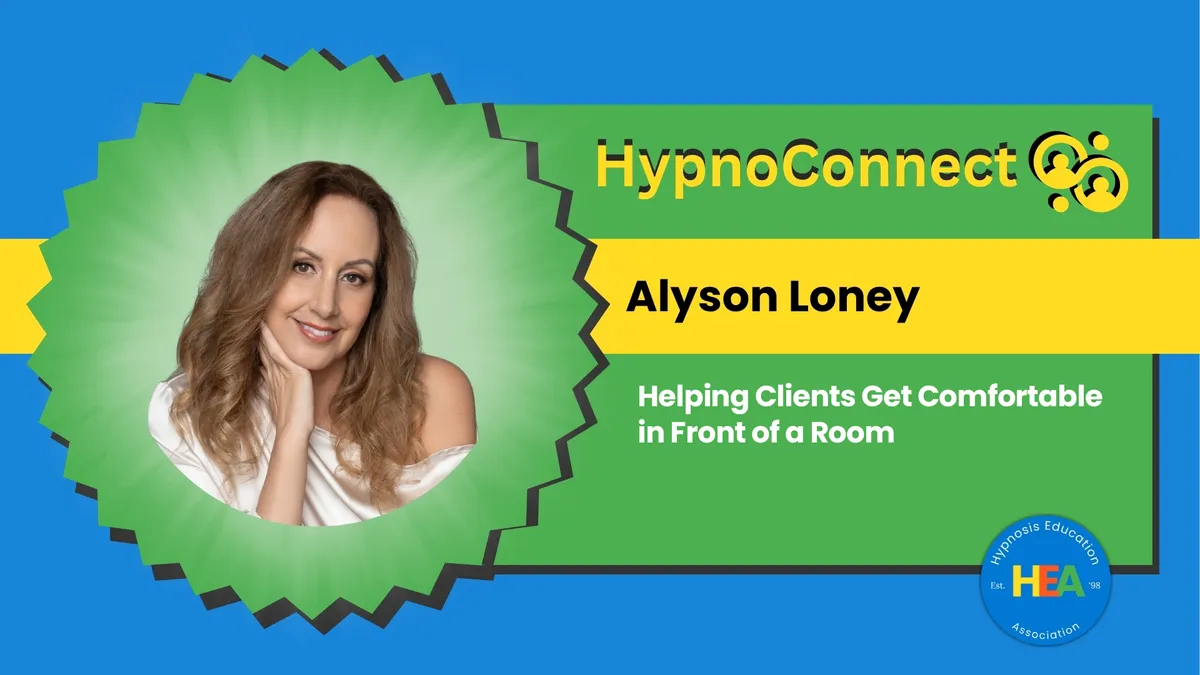
Alyson Loney on Helping Clients Get Comfortable in Front of a Room
Before she was a clinical hypnotherapist, Alyson Loney sold t-shirts with a friend, worked a decade for a Fortune 500 company, trained staff for two celebrity-owned businesses in Los Angeles, and competed as a ballroom dancer.
It was a comedy hypnosis show in Las Vegas, by Marc Savard, that changed her path: she went home, enrolled in a year-long program, and eventually opened Virtus Hypnotherapy in Vancouver.
On this episode of HypnoConnect, Alyson joins host Melanie McCool to talk about the specialty she's moved toward in recent years: helping clients get comfortable presenting themselves, whether that's on a stage, in a boardroom, or simply speaking up socially.
Watch the Full Session
Public Speaking Fear Isn't About Speaking
Alyson opens with a reframe: the term "public speaking" is just a trigger word. Every reason someone fears it, past criticism, a bad experience, low self-esteem, gets attached to that phrase, but the real fear is of an imagined reaction from other people.
She illustrates this with a simple exercise: saying words like judgment, criticism, rejection, and aloneness, then words like calm, support, connection, and comfort, and asking listeners to notice how differently each set lands in the body.
The Attributes Fallacy
Many people believe they need to embody traits like charisma, power, or wisdom before they can speak well. Alyson calls this the attributes fallacy. In her view, only one of those traits actually matters: confidence, and confidence isn't something a person either has or lacks.
Confidence Is Simply Repetition
Alyson's core definition: confidence equals capability, and capability comes from doing something so often it becomes subconscious.
This cuts both ways. Just as helpful habits become automatic with repetition, so do unhelpful ones, which is why simply gathering speaking tips isn't enough. The work is in identifying the belief holding someone back, replacing it, and then repeating the new behavior until it's automatic too.
The Leadership Fallacy
A related myth: that a leader is whoever has all the answers, gives the directions, or dominates the room. Alyson argues the opposite. A leader is simply the most comfortable person in the room, and comfort is legible through body language, tone, and behavior, whether or not that person is the one speaking.
Retraining the Subconscious
Alyson's coaching process starts with identifying a client's limiting beliefs, almost always rooted in a fear of how others will perceive them, something no one can actually control.
Replacing Old Beliefs With New Repetition
Once a limiting belief is identified and made conscious, Alyson works to replace it, then rebuild the new belief into a subconscious habit through repeated practice. The goal isn't a one-time realization; it's enough repetition that the new response becomes automatic.
Why Novelty Helps the Brain Let Go of Old Fear
Because brains respond strongly to novelty, Alyson has clients visualize themselves succeeding in new, vivid imagery rather than simply trying to think positively about the old fear.
She also notes that fear and excitement produce nearly identical physical symptoms, sweaty palms, a racing heart, shortness of breath, which means those same sensations can be reframed and redirected as excitement.
Context-Dependent Behavior: Why Confidence Isn't Fixed
A person can be confident in one setting and lose that confidence entirely in another, because the nervous system reacts to context, not conscious intention. If someone had a bad experience speaking publicly before, their nervous system may take over in a similar context going forward, regardless of how capable they actually are.
Alyson's fix: change the physical environment and the visualized imagery together, so the nervous system stops pattern-matching to the old, unsafe context.
Resetting an Overactive Nervous System
When the amygdala perceives danger, it signals the hypothalamus, the sympathetic nervous system takes over, and the adrenal glands release cortisol and other stress hormones. Alyson is clear that this is an ancient survival response poorly suited to modern speaking situations, where there's no actual physical danger.
A Step-by-Step Technique for Calming Down in the Moment
Alyson's method:
Notice the physical symptoms without reacting.
Ground through the feet.
Tell your nervous system exactly what happens in the next 10 seconds ("I'm going to breathe deeper").
Repeat that in 10-second increments until calm returns.
The underlying idea is that the nervous system escalates when it doesn't know what's coming next, and giving it a plan interrupts that escalation.
Body Language Practitioners Can Actually Teach
Nonverbal communication happens largely below conscious awareness, which is part of why it's so hard to fake. Alyson teaches clients to be intentional with their own body language rather than trying to imitate someone else's.
The Friend-or-Foe Judgment We All Make
Within the first three seconds of meeting someone, Alyson explains, people subconsciously sort each other into "safe" or "dangerous." Speaking slowly, keeping gestures open, showing the palms, and taking up appropriate physical space all read as safety and calm.
The Art of "Blocking" Your Material
Borrowed from theater, blocking means practicing physical movement alongside spoken material, not just the words themselves, so the body learns what to do without conscious thought. Alyson recommends rehearsing from headline points rather than a fully written script, so a speaker can expand naturally rather than reading.
Avoiding Upspeak
Ending a statement with a rising, question-like inflection, sometimes called upspeak or uptalk, signals uncertainty to an audience, even when the content itself is solid. Alyson coaches clients to flatten that inflection deliberately.
Key Takeaways for Practitioners
Public speaking fear is rarely about the act of speaking; it's about an imagined reaction from others.
Confidence isn't a fixed trait. It's built through repetition, the same way any habit is built.
The same person can feel confident in one context and lose that confidence in another; the nervous system, not personality, is often driving the difference.
Giving the nervous system a clear next step, in small time increments, can interrupt an escalating fear response.
Practicing physical movement alongside spoken material ("blocking") helps the body carry material the mind might otherwise fumble.
Small, specific habits, like eliminating upspeak or slowing your pace, can change how an audience reads confidence and certainty.
Practitioners who want to add skills like these to their toolkit can explore HEA's hypnosis education opportunities, and share ideas with peers inside the HEA community.
Join the Next Hypno Connect
Want more conversations like this one? Register for the next live HypnoConnect session, and see the full lineup at our upcoming conferences and events.
Frequently Asked Questions
Why do people who are otherwise confident still fear public speaking?
Alyson explains that the fear usually isn't about speaking itself, but about an imagined negative reaction from an audience. The same person can feel entirely confident in one context and lose that confidence in another, because the nervous system responds to context, not just personality.
What does Alyson mean when she says "confidence is repetition"?
She defines confidence as capability, and capability as the result of doing something so often that it becomes a subconscious, automatic response. Confidence isn't a trait some people are simply born with.
What is context-dependent behavior, and why does it matter for public speaking?
It's the idea that the nervous system reacts based on associations with a specific setting, not on conscious willpower. Someone who had a difficult speaking experience in a similar context before may find their nervous system reacting defensively again, regardless of their actual skill.
How can a hypnotist help a client calm their nervous system before they speak?
Alyson teaches a step-by-step technique: notice physical symptoms without reacting, ground physically, and tell the nervous system exactly what will happen in the next 10 seconds, repeating in short increments until calm returns.
What is "blocking," and why does it help with public speaking?
Borrowed from theater, blocking means rehearsing physical movement alongside spoken material so the body and the words become linked through repetition, reducing the need for conscious thought while speaking.
Where can I learn more about Alyson Loney's approach?
Alyson practices at Virtus Hypnotherapy in Vancouver, Canada, and is developing a more comprehensive program on public speaking and confidence.


