Debbie Waller on Aphantasia and Hypnosis: Working With Clients Who Cannot Visualize
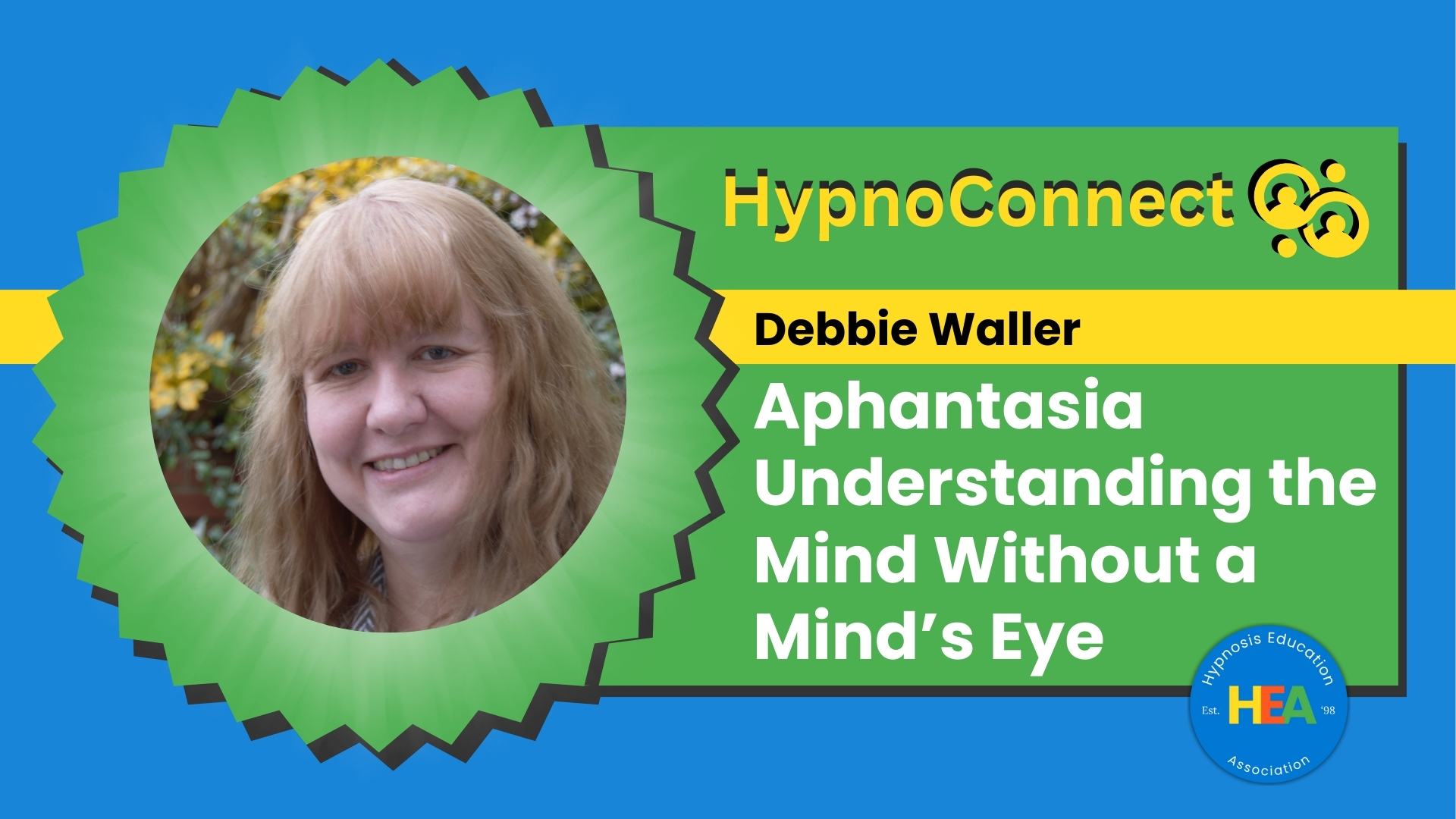
During a Hypno Connect session hosted by the Hypnosis Education Association (HEA), hypnotherapist, trainer, and author Debbie Waller explored aphantasia and what it means for hypnosis practitioners.
Debbie brings a particularly useful perspective to the subject. She has more than 20 years of hypnotherapy experience and has aphantasia herself. In fact, she did not realize other people literally experienced pictures in their minds until her hypnotherapy and NLP training introduced her to visualization exercises.
For practitioners, her message was important: imagination and visualization are not the same thing.
A client who cannot create mental pictures can still imagine, think, remember, respond to hypnosis, and engage with therapeutic processes. The practitioner's job is to discover how that particular client processes experience and adapt accordingly.
Want to learn from hypnosis professionals sharing insights like these? Join HEA and become part of a community built around exactly this kind of practical, practitioner-led exchange.
Watch the full session here
Listen to the podcast version here
What Is Aphantasia?
Aphantasia refers to reduced or absent voluntary mental imagery.
Someone with aphantasia may know exactly what something looks like without actually seeing a mental picture of it.
Debbie used the Mona Lisa as an example. She can describe the famous painting because her brain has stored information about it. However, when she thinks about it, she does not see an internal picture. Her experience is more like receiving a description through words.
Aphantasia can also exist on a spectrum. Some people experience no voluntary imagery, while others may occasionally experience images involuntarily or while dreaming.
For hypnosis practitioners, this matters because many familiar techniques assume clients can visualize.
Imagination Does Not Require Mental Pictures
The Front Door Misconception
One misconception Debbie addressed was the idea that asking a client the color of their front door can prove they are visualizing.
A person with aphantasia might know their front door is white without mentally seeing it.
They simply know.
The distinction is important because trying to convince a client that they are secretly visualizing can create unnecessary frustration.
Instead, practitioners can accept that clients process information differently and work with the abilities they already have.
"Imagine" Can Be More Inclusive Than "Visualize"
Debbie recommends paying close attention to therapeutic language.
Instead of:
"See yourself walking across a meadow."
A practitioner might say:
"Imagine walking across a meadow."
Or:
"Think about what it might be like to walk across a meadow."
A visual client can naturally turn "imagine" into pictures. A nonvisual client can interpret the same instruction through thoughts, sensations, sounds, spatial awareness, or whatever form works naturally for them.
This small language change can make hypnosis more inclusive without disrupting the experience for clients who do visualize.
Discover How Your Client Actually Imagines
Do Not Assume Clients Think Like You
One of Debbie's most practical recommendations was to explore how clients internally represent experiences.
A peaceful-place exercise can help.
Rather than requiring the client to see a detailed scene, invite them to imagine somewhere comfortable and then explore what naturally arises.
Afterward, ask:
"How did you imagine that?"
The client might say they could not see the beach, but they could hear seagulls. Perhaps they could feel the sand beneath their feet or simply knew where they were.
That feedback gives the practitioner useful information for future sessions.
The goal is not to force clients into the practitioner's preferred sensory system. It is to learn how the client already thinks.
Adapting Hypnosis Techniques for Aphantasia
Choose Techniques That Fit the Client
Some hypnosis and NLP techniques place heavy demands on visual imagery.
For example, an exercise that asks a client to create a mental movie, change it from color to black and white, move it around, reverse it, and alter its speed may become difficult for someone who struggles to generate visual images.
Debbie suggested that practitioners consider alternatives that rely less heavily on visualization, including approaches with a stronger kinesthetic component.
The principle is straightforward:
Adapt the technique to the client rather than expecting the client to adapt to the technique.
Use Physical Props When Mental Imagery Is Difficult
Another practical option is to make something external that would otherwise need to be imagined internally.
For example, if a client has difficulty mentally locating a feeling in the body, the practitioner could provide an outline of a person and ask the client to draw where the feeling belongs.
Similarly, a timeline can be drawn rather than mentally visualized.
Photographs can also help when working with memories. If a client struggles to access detailed autobiographical memories, physical photos may provide useful prompts.
Debbie discussed using visible images before guided imagery as well. If the practitioner plans to use a beach metaphor, for example, the client could first choose from photographs of different beaches. The practitioner can then build language around a scene the client has physically seen.
Be Careful With Visual Language
Practitioners should also avoid assuming that a client's everyday language reveals exactly how they think.
Someone with aphantasia may still say:
"I see what you mean."
That does not necessarily mean they experience visual imagery.
These expressions are simply part of ordinary language.
Debbie therefore encouraged practitioners to use more flexible terms such as:
"Imagine..."
"Think about..."
"Remember..."
"Consider what it might be like..."
This gives clients greater freedom to process suggestions in their own way.
Get Feedback and Keep Adapting
Perhaps the simplest lesson from Debbie's presentation was also one of the most useful:
Ask the client.
Nonvisual clients may not automatically tell a practitioner that a visualization is not working. They may simply follow along as best they can.
Debbie recommends checking in after exercises and sessions.
How did they experience the exercise?
What worked?
What did not?
Were there sounds, sensations, thoughts, or simply a sense of knowing?
That feedback allows the practitioner to refine future sessions around the client's actual experience rather than assumptions about how hypnosis is "supposed" to happen.
Aphantasia Is a Difference, Not a Failure of Imagination
A major theme throughout Debbie's presentation was recognizing aphantasia as a form of human cognitive diversity rather than automatically treating it as something that needs fixing.
Someone may be unable to generate mental pictures while still having strong spatial awareness, imagination, intelligence, creativity, and other ways of processing information.
During the discussion, participants reinforced the distinction between imagination and visualization, including examples of people with aphantasia who still demonstrated excellent spatial abilities.
For hypnosis professionals, this perspective changes the question.
Instead of asking:
"How do I make this client visualize?"
ask:
"How does this client imagine, and how can I work with that?"
That question opens far more possibilities.
Join the Next Hypno Connect
Debbie Waller's presentation offers hypnosis practitioners a valuable reminder that clients do not all experience their inner worlds in the same way.
A technique that works beautifully for a highly visual client may need adjusting for someone with aphantasia. That adjustment can be as simple as changing "visualize" to "imagine," exploring other senses, introducing physical props, choosing a different technique, or asking the client how they naturally process experience.
Ultimately, effective hypnosis is not about making every client think the same way. It is about meeting the client where they are and adapting the work accordingly.
Hypno Connect brings hypnosis professionals together to explore practical topics like these, exchange perspectives, and learn from practitioners with firsthand experience, alongside the full lineup covered at our upcoming conferences and events.
Frequently Asked Questions
What is aphantasia?
Aphantasia describes reduced or absent voluntary mental imagery. A person may understand and imagine something without experiencing it as a mental picture.
Can someone with aphantasia be hypnotized?
Aphantasia does not mean someone cannot imagine or engage with hypnosis. Practitioners may simply need to adapt techniques that depend heavily on visual imagery.
Is imagination the same as visualization?
No. Visualization is one way of imagining. People can also imagine through words, sounds, sensations, spatial awareness, concepts, or a sense of knowing.
How can hypnotists adapt visualization exercises for aphantasia?
Practitioners can use more inclusive language, explore nonvisual senses, provide physical images or props, draw timelines, and choose techniques that do not require complex mental pictures.
Should hypnotists stop using visual language entirely?
Not necessarily. The goal is flexibility. Words such as "imagine," "think about," and "remember" allow each client to interpret the suggestion in whatever way comes naturally.
Why is client feedback especially important with aphantasia?
A nonvisual client may follow an imagery exercise without mentioning that they cannot see anything internally. Asking how they experienced the exercise helps the practitioner adapt to future sessions.
How can I attend Hypno Connect?
The Hypnosis Education Association hosts Hypno Connect sessions where hypnosis professionals share practical techniques, research, experiences, and perspectives. Register for the next Hypno Connect here.


