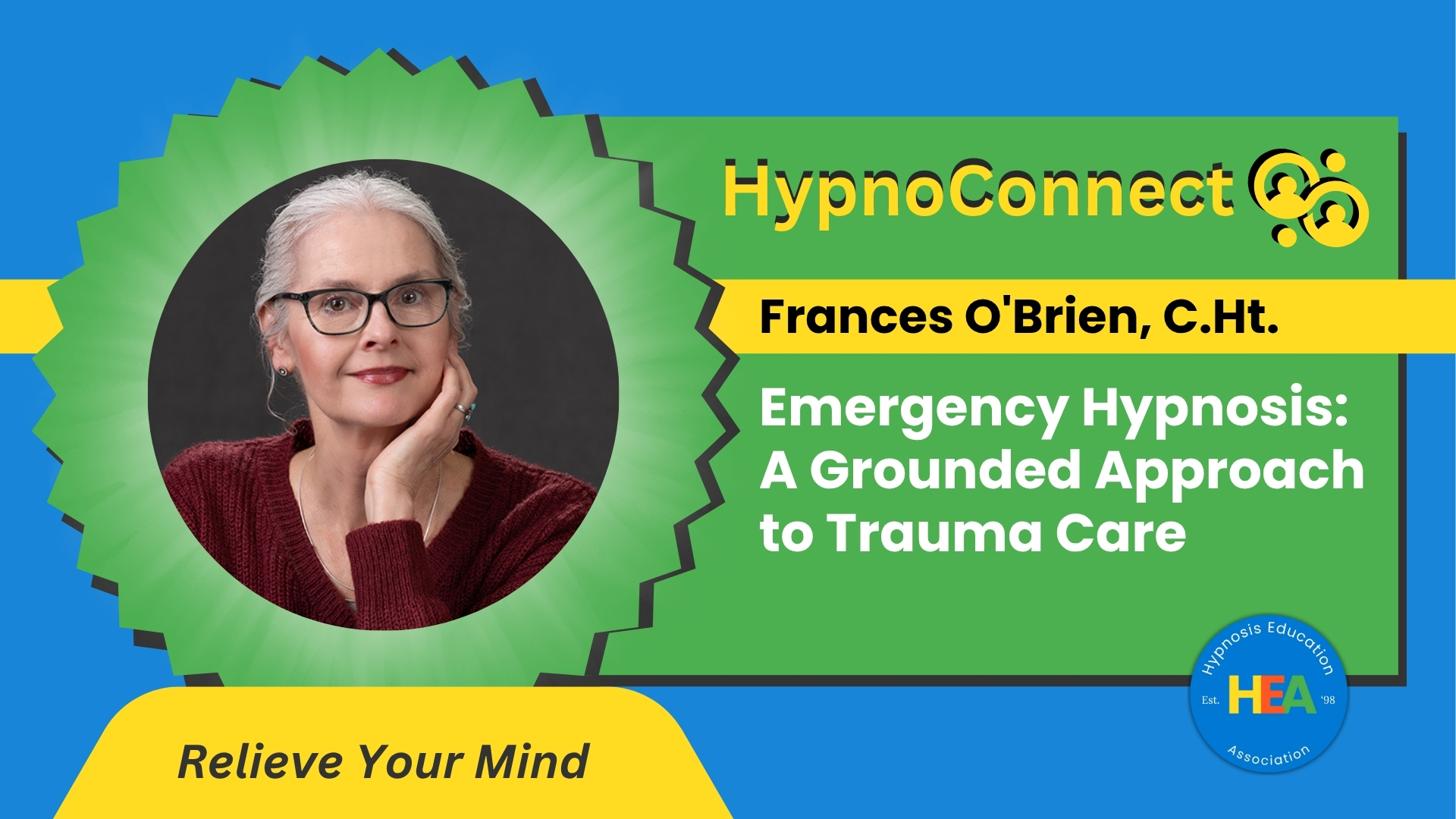
Hypnosis, Verbal First Aid, and Hope After Trauma (Frances O'Brien)
In an educational Hypno Connect session hosted by the Hypnosis Education Association (HEA), clinical hypnotherapist and Relieve Your Mind owner Frances O'Brien explored one of the most fundamental questions in the field: what is hypnosis? Her presentation moved beyond common misconceptions and into the practical use of language during trauma, including the concept of emergency hypnosis and "verbal first aid." O'Brien also discussed how practitioners, family members, friends, and even bystanders can support people after frightening or significant experiences without trying to control their healing process. Whether you are new to hypnosis or looking to strengthen your understanding of trauma-informed communication, register for Hypno Connect to continue learning from hypnosis professionals through the HEA community.
Watch the full session here:
Prefer to listen instead? You can also catch this session on the HEA podcast.
Understanding What Hypnosis Really Is
Hypnosis Is Not Mind Control
O'Brien began by addressing one of the most common misconceptions about hypnosis: that a hypnotist takes control of another person's mind.
She emphasized that hypnosis involves participation and agreement from the person experiencing it. Even stage hypnosis, which can appear dramatic or controlling, generally involves volunteers who are already willing to participate in the experience.
For O'Brien, understanding this distinction is important because hypnosis should not be viewed as something one person simply "does" to another.
A Natural State of Focus
O'Brien described hypnosis as a normal state people experience regularly.
She connected it with periods of focused or absorbed attention, such as becoming deeply involved in a movie, driving a familiar route while thinking about something else, or being so preoccupied with a person or thought that attention temporarily shifts away from the immediate environment.
She also discussed the transition periods before sleep and after waking as times when people may be particularly receptive to suggestions.
This led to a practical recommendation: be thoughtful about what you expose yourself to during these periods. Positive reflection, meditation, gratitude, and affirmations may be more supportive than immediately filling the mind with stressful or negative information.
Emergency Hypnosis and Verbal First Aid
What Happens During Trauma?
A major part of O'Brien's presentation focused on what she called emergency hypnosis.
Following a significant trauma, such as an accident, fire, natural disaster, fall, or sudden loss, a person may enter a highly focused or shocked state. During that time, the language and emotional presence of the people around them can have a powerful impact.
O'Brien introduced the concept of verbal first aid, referencing the book The Worst Is Over by Judith Acosta and Judith Simon Prager.
The idea is simple: alongside appropriate emergency response, calm and carefully chosen language may help a frightened person begin to feel safer.
"The Worst Is Over"
One of the central phrases O'Brien discussed was:
"The worst is over."
After an immediate danger has passed, someone experiencing shock may still feel as though the frightening event is continuing.
A calm statement that the worst part has ended can help orient the person toward the present moment.
O'Brien recommended first contacting emergency services when needed, then taking a brief moment to center yourself before approaching the person. A calm voice, steady presence, and confident communication can reduce additional fear.
Using Positive Language During an Emergency
Tell the Person What Is Happening
O'Brien emphasized the importance of narrating what is happening around someone who has experienced trauma.
For example, you might let them know that help is on the way, that you will remain with them, or that emergency responders are approaching.
Using the person's name, when known, can also help maintain their attention and connection.
If physical contact is necessary, O'Brien recommended telling the person before touching them whenever possible. This helps prevent an already distressed person from being startled further.
Focus on Safety and Support
O'Brien encouraged the use of calm, reassuring language such as:
"You are safe." "Help is coming." "I am here with you." "The worst is over."
The purpose is not to promise an outcome you cannot guarantee. Instead, the language communicates presence, support, and movement toward safety.
During the discussion, HEA hosts reflected on how powerful this type of phrasing can be, including within hypnotherapy sessions when clients are processing traumatic experiences.
Finding Hope After Trauma and Loss
Trauma Can Make Hope Difficult to See
O'Brien also discussed what happens after the immediate emergency has passed.
People who experience the death of someone close to them, loss of a home, natural disaster, job loss, serious diagnosis, or another major life disruption may begin defining themselves through what happened.
When someone is deeply immersed in grief or trauma, imagining a better future can be difficult.
O'Brien suggested that supportive people can temporarily help hold space for hope until the individual can begin accessing it themselves.
Holding Space Can Be Simple
Helping does not always require saying something profound.
O'Brien described holding space as listening while someone talks, sitting quietly while they cry, offering a meal, providing a hand to hold, or simply being present.
Practical support can matter too.
Someone may need help locating disaster resources, food assistance, shelter, financial support, or affordable counseling. Researching those options for them can reduce the burden when they are already overwhelmed.
Respecting Each Person's Healing Timeline
Never Tell Someone They Should Be "Over It"
One of O'Brien's strongest cautions was against deciding how long another person should take to recover.
Trauma and grief are defined by the person experiencing them.
Someone may mourn a death, home, relationship, career, health change, or another major loss for far longer than others expect.
O'Brien stressed that telling someone they should be "over it by now" can be dismissive and harmful.
Support can be offered, but healing cannot be forced.
Offer Help Without Taking Away Choice
If someone continues struggling long after an event, suggesting professional support may be appropriate.
O'Brien encouraged people to help locate accessible options if finances are a concern, including lower-cost or sliding-scale services where available.
However, adults ultimately have the right to decide whether they accept that help.
Part of supporting someone is respecting that choice, even when watching them struggle is difficult.
Practical Lessons for Hypnotherapists
Language Matters
The session reinforced something hypnotists already understand well: words influence experience.
During moments of stress, trauma, or deep emotional focus, the way a practitioner speaks can either add to uncertainty or create a greater sense of safety.
O'Brien's examples of verbal first aid showed how pacing, reassurance, and clear communication can become useful tools beyond formal hypnosis sessions.
Calm Yourself First
Another important lesson was the practitioner's own emotional state.
Before helping someone in distress, O'Brien recommended taking a brief moment to breathe, center, or ground yourself.
A person in shock may be highly sensitive to the emotional tone of those nearby.
Showing up calmly can therefore become part of the support being offered.
HEA's Community of Hypnosis Education
The Hypnosis Education Association brings together hypnosis professionals, educators, students, and people interested in understanding hypnosis more accurately.
Hypno Connect sessions provide opportunities to revisit foundational topics while also exploring practical applications that may not always receive extensive attention during hypnosis training.
O'Brien's session demonstrated that even a basic question such as "What is hypnosis?" can open the door to deeper conversations about trauma, language, presence, compassion, and responsible support.
Join Hypno Connect: Learn Practical Applications of Hypnosis
Frances O'Brien's presentation offered a grounded reminder that hypnosis is not simply a formal technique used inside a session room.
Focused states, suggestion, language, and emotional presence can appear throughout everyday life and can become especially important during moments of fear or trauma.
Her discussion of verbal first aid encouraged practitioners to use calm language, support safety, respect grief, offer practical help, and avoid forcing another person's healing timeline.
To continue learning about hypnosis techniques, professional practice, client communication, and real-world applications of hypnosis, register for the next Hypno Connect through the Hypnosis Education Association.
Frequently Asked Questions
What is hypnosis?
Hypnosis is a focused state of awareness and increased responsiveness to suggestion. Frances O'Brien described it as a natural experience that can occur during everyday activities such as becoming absorbed in a movie, driving a familiar route, or transitioning between waking and sleep.
What is emergency hypnosis?
Emergency hypnosis refers to using calm, intentional communication with someone who may be in a highly suggestible or shocked state following trauma. O'Brien discussed it alongside the concept of verbal first aid and emphasized that emergency services should always be contacted when appropriate.
What is verbal first aid?
Verbal first aid involves using reassuring, clear, and supportive language with a person experiencing trauma or shock. Statements such as "help is coming," "I am here with you," and "the worst is over" can help communicate safety and orientation after an emergency.
How can you support someone after trauma or loss?
Support may include listening, sitting quietly with the person, offering practical assistance, helping locate resources, or suggesting professional care when appropriate. O'Brien emphasized respecting the individual's pace and never telling someone they should already be over their loss.
What is Hypno Connect and how can I register?
Hypno Connect is an educational event hosted by the Hypnosis Education Association where hypnosis professionals share techniques, practical experiences, and perspectives from the field. You can register for the next Hypno Connect through the Hypnosis Education Association.
Frances O'Brien is a member of the Hypnosis Education Association. Visit relieveyourmind.com or find her in our member directory.


