
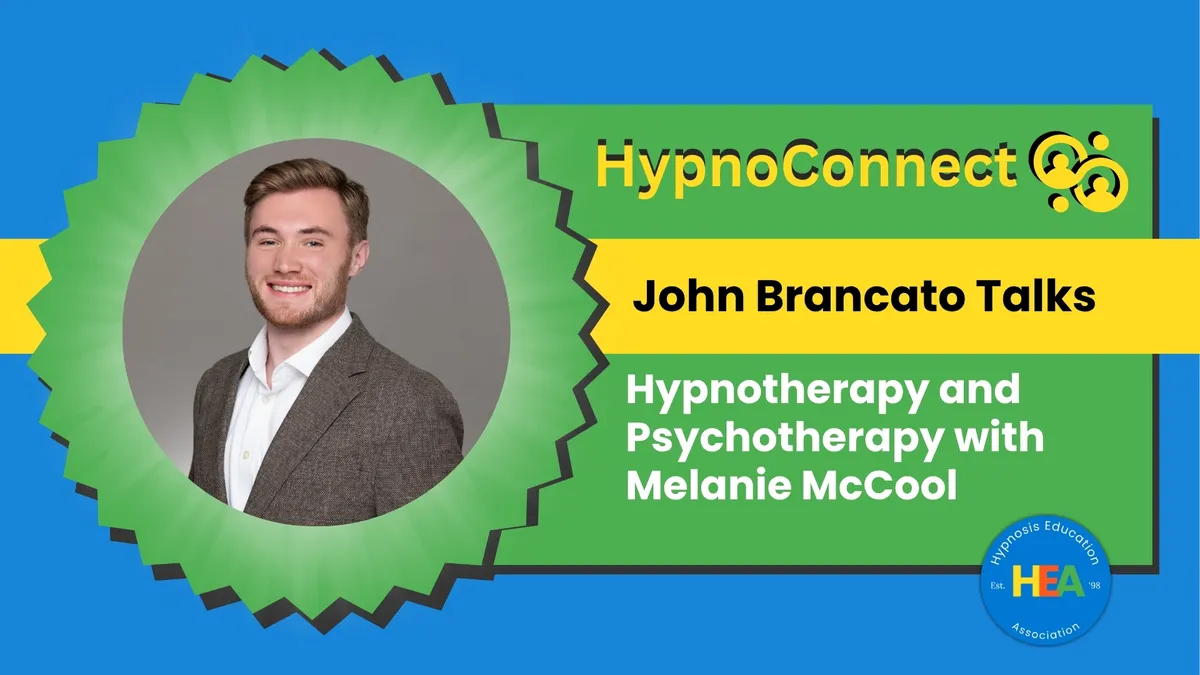
John Brancato on Blending Hypnosis with Psychotherapy
During a Hypno Connect session hosted by the Hypnosis Education Association (HEA), host Melanie McCool sat down with clinical supervisor and psychotherapist John Brancato, LMHC, BCH to explore how hypnosis and psychotherapy can work together instead of in competition. HEA vice president Shawn Bray joined the conversation as well, rounding out a discussion aimed squarely at practitioners who want to do more than manage symptoms.
John brings a particularly useful perspective to the subject. He is a licensed psychotherapist and clinical supervisor at The Soho Center for Mental Health Counseling in New York City who is also a board certified hypnotherapist, and he built his integrated framework through years of combining both fields in long-term client work.
For practitioners, his message was important: psychotherapy and hypnosis are not competing for the same job. They work in fundamentally different directions, and real healing tends to need both.
A client's symptom, in John's framing, is not something to eliminate as quickly as possible. It's a signal. The practitioner's job is to understand what that signal is communicating and to bring the right modality, at the right depth, to help the client actually transform rather than simply feel better for a while.
Watch the Full Session
What Is the Difference Between Psychotherapy and Hypnosis?
Psychotherapy, per the NIH's definition, covers a wide variety of treatments that help a person identify and change troubling emotions, thoughts, and behaviors. Because that change starts with identifying and consciously choosing something different, John described psychotherapy as fundamentally top-down: it works from the conscious, cognitive mind and hopes the change trickles down into emotion and behavior.
Hypnosis works the other way. Citing the APA's definition (a state of consciousness involving focused attention and reduced peripheral awareness) alongside Milton Erickson's view that hypnosis lets clients reassociate and reorganize their own inner psychological contents, John described hypnosis as bottom-up: change starts in the unconscious mind and only afterward moves up into conscious awareness, where the client still has to choose to carry it forward.
Neither direction is wrong. They simply start from opposite ends of the same system, which is exactly why John sees them as complementary rather than competing, and why he encourages practitioners trained in only one to at least understand how the other operates. Practitioners looking to build that second skill set can explore HEA's hypnosis education opportunities.
Psychotherapy and Hypnosis Are Not Competing Modalities
Where Psychotherapy Shines, and Where It Struggles
Used well, psychotherapy builds insight, a strong therapeutic alliance, and supports real conscious decision-making. John was equally direct about its limits: analysis paralysis, slow change when resistance runs high, and limited access to unconscious resources in most approaches.
Where Hypnosis Shines, and Where It Struggles
Hypnosis gives direct access to unconscious processes, bypasses resistance, and is remarkably effective for habit change and symptom relief. On its own, though, it can lack a broader context for meaning, miss underlying relational issues, and depend heavily on a client's actual readiness for change.
Symptoms Are Signals, Not Problems to Erase
The "Just Erase It" Misconception
One misconception John addressed head-on is the idea that hypnosis's speed at removing a symptom is the whole point of the work. A client who simply wants to quit smoking may need nothing more than a straightforward hypnosis session, and John says so plainly: don't waste that client's time with anything else. But when a symptom is standing in for something deeper, erasing it without addressing what's underneath doesn't delete the underlying file. Something else tends to surface in its place.
Self-Organization Instead of Self-Regulation
John also pushed back on the idea that the goal of therapy is returning a client to a stable baseline. Self-regulation, in his framing, is what a thermostat does: it maintains a set point and nothing more. Living systems don't just regulate, they self-organize, repatterning toward a new, higher-order state the client has never actually been in before. Aiming clients back at an old "good time" in their life, John argued, can quietly hold them back from something better.
Discover How Your Client's System Actually Communicates
Do Not Assume Every Client Needs the Same Sequence
Just as a practitioner shouldn't assume every client processes experience the same way, John cautioned against assuming every client needs hypnosis and psychotherapy in the same order or depth. Some clients need fast, focused symptom relief. Others need the slower work of insight and relational repair before hypnosis can do anything useful. Reading which one is in front of you, John suggested, matters more than any fixed protocol.
Adapting the Integration to Each Client
Use the Therapeutic Relationship as a Container
In his own long-term psychotherapy work, John treats the therapeutic relationship itself as a container for healing. Corrective emotional experiences, being fully heard for perhaps the first time, can be transformative on their own, and they set up the safety a client needs before deeper hypnotic work.
Bring In Standard Trance Work When the Client Is Ready
When he does move into hypnosis, John uses familiar tools: metaphor, future pacing, imaginal rehearsal, and age regression. He also draws on Ericksonian methods and Ernest Rossi's Mirroring Hands approach, which puts the symptom quite literally in the client's own hands and keeps the practitioner's role deliberately non-directive.
Be Careful With Symptom-Focused Language
Practitioners should be cautious about labeling a client's pushback as "resistance." John doesn't believe resistance exists as a fixed trait. In his view, when something isn't working, it usually means the approach needs to change, not the client. Language that treats a client's caution or hesitation as an obstacle to overcome can create the very stuckness it's meant to describe.
Get Feedback and Keep Adapting
Clients won't always volunteer that a technique isn't landing. John recommends staying closely attuned to what's actually happening in the room: is the client accessing something real, or just generating information about themselves without any felt change? That distinction, between intellectualizing and truly experiencing, is one of the clearest signs of whether an approach needs to shift.
Integration Is a Practice, Not a Formula
A central theme of John's presentation was that combining hypnosis and psychotherapy isn't a fixed recipe. It's an ongoing dialogue between two ways of working that each cover what the other misses. Practitioners don't need to choose a side. The more useful question isn't "which modality is better," but "what does this client need right now, and which approach gets them there." Conversations like this are a big part of why practitioners join the HEA community.
Key Takeaways for Practitioners
Treat symptoms as signals worth understanding, not obstacles to eliminate on sight
Match the modality and depth of intervention to what the individual client actually needs, not a fixed protocol
Use the therapeutic relationship itself as a container before introducing deeper hypnotic work
Watch for the difference between a client intellectualizing an insight and actually experiencing it
Expect integration to be an ongoing practice you refine session by session, not a technique you master once
Join the Next Hypno Connect
John Brancato's presentation offers hypnosis and psychotherapy professionals a valuable reminder that fast symptom relief and lasting transformation aren't always the same goal, and that clients are often better served when practitioners know which one they're working toward.
Hypno Connect brings hypnosis professionals together to explore practical topics like these, exchange perspectives, and learn from practitioners with firsthand experience, alongside the full lineup at our upcoming conferences and events.
Register for the next Hypno Connect to join an upcoming session hosted by Melanie McCool and the HEA team.
Frequently Asked Questions
What is the core difference between hypnosis and psychotherapy?
Psychotherapy works top-down, starting with the conscious mind and aiming for insight and behavior change. Hypnosis works bottom-up, starting with the unconscious mind and producing direct, experiential change that later moves into conscious awareness.
Can hypnosis and psychotherapy be used together safely?
Yes. John integrates both in his own long-term psychotherapy practice, using hypnosis for deep, unconscious-level work and psychotherapy to give that change context, meaning, and real-world follow-through.
Is fast symptom relief from hypnosis a bad thing?
No. For a client who wants a specific, isolated change, like quitting smoking, hypnosis alone can be exactly the right tool. The caution only applies when a symptom is a stand-in for something deeper.
What does John mean by treating symptoms as "signals, not problems"?
He means a symptom like anger or a physical complaint is the mind-body system communicating an unmet need, not simply a malfunction to be erased. Understanding what a symptom is trying to say is often more useful than suppressing it.
What is the difference between self-regulation and self-organization?
Self-regulation is a system returning to a prior baseline, like a thermostat maintaining a set temperature. Self-organization is a living system repatterning toward a new, higher-order state it hasn't been in before.
How can psychotherapists start learning to integrate hypnosis into their work?
John suggests starting with foundational hypnosis training, such as Ericksonian approaches and Ernest Rossi's work, and treating it as a genuine second skill set rather than a technique layered onto existing talk therapy.


