Linda Thunberg on Building a Hypnosis Career, and an Association, That Lasts
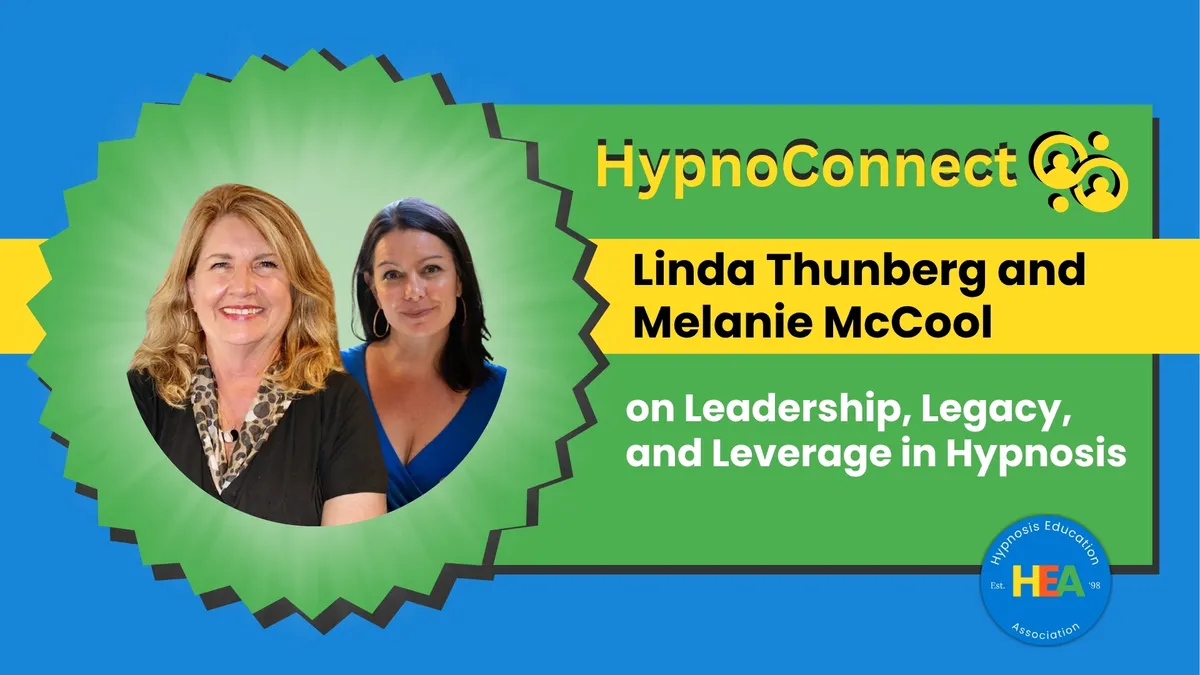
During a Hypno Connect session, Linda Thunberg, MHt, CCP, President and CEO of the National Association of Transpersonal Hypnotherapists (NATH), joined a wide-ranging conversation on leadership, legacy, and building a hypnosis business that lasts. HEA vice president Shawn Bray co-hosted.
Rather than a single technique, this session offered something practitioners rarely get: an honest look at the business and leadership side of a hypnosis career, from Linda's own winding path into the field to the practical marketing moves that actually filled her caseload.
Watch the Full Session
Listen to the Podcast
Prefer to listen on the go?
LISTEN TO THE FULL PODCAST EPISODE: Leadership, Legacy, and Leverage with Linda Thunberg →
From the Stock Market to Interior Design to Hypnotherapy
Linda spent 15 years in the stock market before a decade-long career as a high-end interior designer, one that ended when the 2007 housing market collapse dried up demand for her services.
A friend, noticing how intuitively she talked about the subconscious mind, suggested hypnosis. Within two weeks, Linda was in a class with NATH founder Dr. Allen Chips, and she never looked back.
What connects all three careers, in Linda's telling, is pattern recognition: reading patterns in the stock market, reading a client's design preferences, and now reading what a hypnosis client wants and needs.
What Is Transpersonal Hypnotherapy?
Transpersonal hypnotherapy, as Linda describes it, brings a client's own spiritual or energetic dimension into the session alongside standard clinical technique, turning a typical two-person hypnotherapist-and-client session into what she calls a triangle.
Her own practice spans clinical hypnosis for weight loss, smoking cessation, stress, and pain management, all the way through past-life regression and life-between-lives work, a modality she uses selectively, based on what each client is actually looking for.
Taking Over NATH After Its Founder's Passing
Why Linda Closed Two Wellness Centers to Lead Full-Time
Dr. Allen Chips, who co-founded NATH with his wife Dee Chips in 1989, passed away in 2012. Dee ran the organization for several years afterward before asking Linda, whom she felt had both the business skills and the hypnosis training to take it forward, to step in.
Linda closed two wellness centers to do it, while refusing to give up her own clients in the process.
Growing NATH Into NATH.world
Linda deliberately built the organization's web presence around NATH.world rather than a national domain, reflecting NATH's growth into an international community that now trains students from as far away as China and Israel.
Marketing a Hypnosis Practice Without a Big Budget
Group Hypnosis as a Scalable Entry Point
Linda built much of her own practice on group hypnosis, run in everyday settings such as:
A bridal shop, offering brides-to-be a pre-wedding weight-loss session
A Verizon store whose sales team needed a confidence boost
Her rule of thumb: a well-run group session can convert roughly 60% of attendees into some form of repeat business, whether that's a private session or a future group event, without requiring a practitioner to reinvent their offer each time.
Word-of-Mouth Still Works
Linda shared two stories that stuck with her:
A bartender who recommended her by name to a customer at the next seat
An office manager, three years after Linda had left that city, who still knew her as "the spiritual hypnotherapist"
Her takeaway for practitioners: talk about what you do, everywhere, and let referrals compound over time. Conversations like this one are a big part of why practitioners join the HEA community.
Building a Niche Practice Online
One attendee, building a sports hypnotherapy practice from a remote small town, asked how to get online groups to book when most prospects preferred in-person work.
Linda's advice: decide on the outcome you're building toward first, whether that's an online group program or in-person visits to specific cities, then market consistently toward that one outcome rather than waiting for interest to arrive on its own. She pointed specifically to LinkedIn as an underused channel for practitioners working with professional or team-based clients.
Finding Your Superpower
Asked what separates practitioners with strong technical skills from those who also build a sustainable business, Linda and the group kept returning to one idea: know your own superpower, the thing you offer that's genuinely different, and be willing to say it plainly and often.
As Melanie put it, that often means practicing how to describe what you do until it lands the way a simple sign in her own office does: "Hypnotherapy. Break bad habits, achieve your goals." Practitioners who want to sharpen both their skills and their message can explore HEA's hypnosis education opportunities.
Key Takeaways for Practitioners
Look for the pattern connecting your own past careers to the way you now work with clients
Group hypnosis, run consistently, can be one of the most scalable ways to build a caseload
Word-of-mouth compounds over years; keep telling people plainly what you do
Decide on a specific outcome before marketing an online or niche offer, then build consistently toward it
Know your own "superpower" and practice saying it clearly, rather than leading with credentials alone
Leading a hypnosis association is a different kind of work from growing a private practice, and both take real sacrifice
Join the Next Hypno Connect
Linda Thunberg's conversation with Melanie McCool is a reminder that a lasting hypnosis career takes more than technique: it takes a clear sense of your own pattern, a willingness to market plainly, and, for some, the willingness to lead.
Hypno Connect brings hypnosis professionals together to explore practical topics like these, exchange perspectives, and learn from practitioners with firsthand experience, alongside the full lineup at our upcoming conferences and events.
Register for the next Hypno Connect to join an upcoming session hosted by Melanie McCool and the HEA team.
Frequently Asked Questions
What is transpersonal hypnotherapy?
It's an approach that brings a client's own spiritual or energetic dimension into a hypnosis session alongside standard clinical technique, turning the session into a three-way collaboration between practitioner, client, and the client's own inner material.
What is NATH?
NATH, the National Association of Transpersonal Hypnotherapists, is a professional hypnosis organization co-founded by Dr. Allen and Dee Chips in 1989. Linda Thunberg has served as its President and CEO since 2017.
Is group hypnosis an effective way to build a hypnosis business?
Linda Thunberg reports that a well-run group session can convert around 60% of attendees into further business, making it one of the more scalable, lower-cost ways for a practitioner to build a caseload.
Do I need a big marketing budget to grow a hypnosis practice?
Not necessarily. Linda's own practice grew largely through group hypnosis events and word-of-mouth referrals built up over years, rather than paid advertising.
How can I market a niche hypnosis practice, like sports hypnotherapy, from a small town?
Decide on a specific outcome, such as an online group program, and market consistently toward it. Linda pointed to LinkedIn in particular as an effective, underused channel for reaching professional and team-based clients.
Can clinical and transpersonal hypnosis coexist in the same practice?
Yes. Linda maintains both, offering purely clinical work for clients who want it and transpersonal or regression-based work for clients who are looking for that, and NATH itself maintains separate clinical, transpersonal, and business tracks at its own conference.


