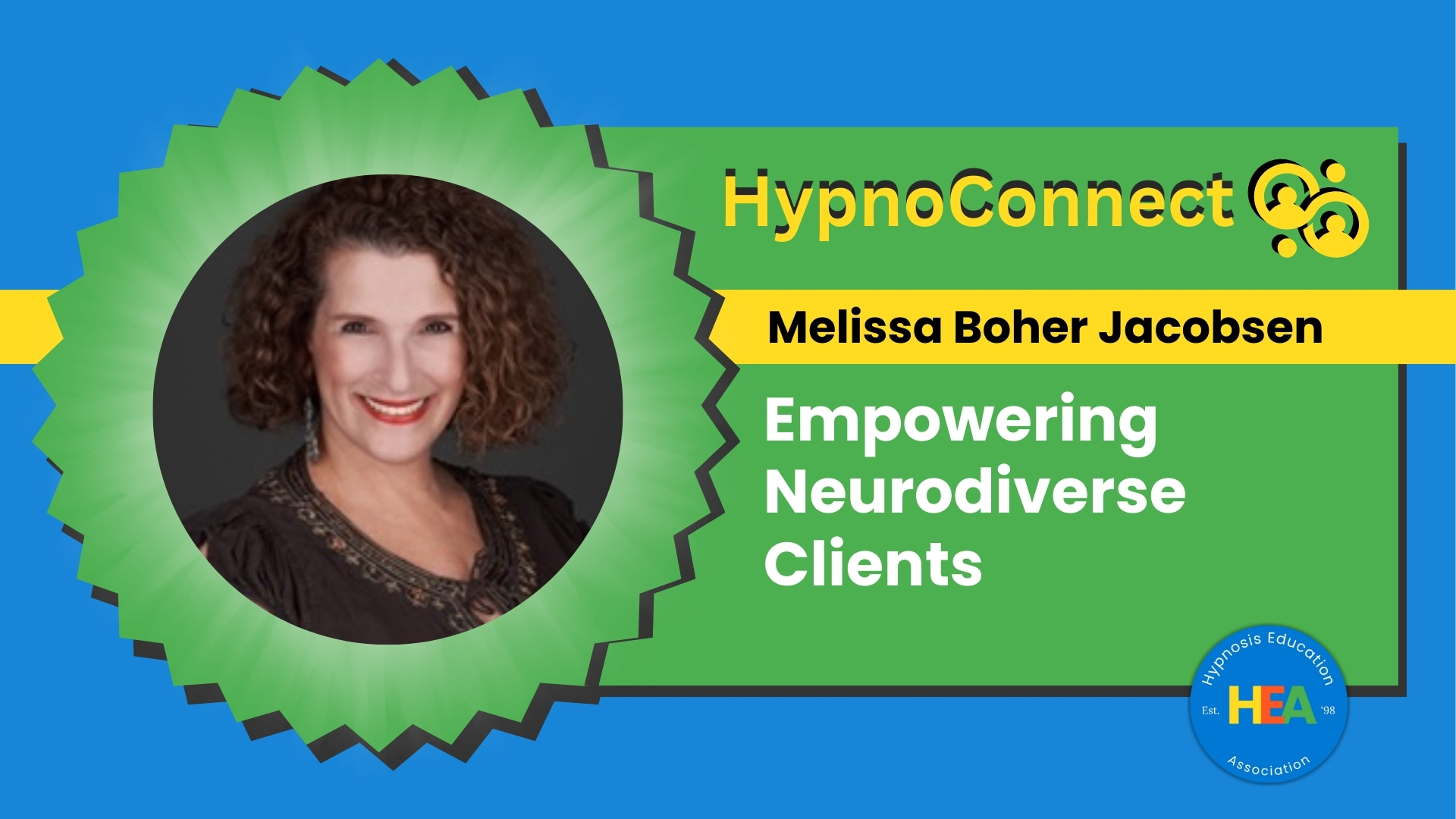
Melissa Boher Jacobsen on Empowering Neurodiverse Clients Through Hypnotherapy
In the world of hypnosis and personal development, few topics are as timely and transformative as supporting neurodiverse individuals. In a recent presentation for the Hypnosis Education Association's (HEA) HypnoConnect series, Melissa Boher Jacobsen, a confident life coach and clinical hypnotherapist with over 24 years of experience, delivered a compelling talk titled "Confidence Coaching and Hypnotherapy for Neurodiverse Clients." As the featured guest, Jacobsen shared her expertise in empowering adults, teens, couples, and families, particularly those who are neurodiverse.
Watch the full HypnoConnect session with Melissa Boher Jacobsen on YouTube ▶
This session highlighted the unique strengths of neurodiverse people and practical strategies for hypnotists to make a meaningful impact. If you're a professional in hypnosis or simply curious about how hypnotherapy can foster self-esteem and success in this underserved community, this blog dives deep into the key takeaways from the video.
Understanding Neurodiversity: Beyond Labels and Misconceptions
Jacobsen kicked off her talk by demystifying neurodiversity, emphasizing that it's not a flaw but a natural variation in how brains function. She explained that everyone's brain is unique, shaped by factors like family of origin, culture, genetic memory, and personal experiences. This uniqueness means that, in a way, 100% of people could be considered neurodiverse because we all have distinct strengths and weaknesses that allow us to learn from one another.
Drawing from her busy practice in South Florida, where she works with clients worldwide, Jacobsen noted that an estimated one in five people falls under the neurodiverse category. However, she suggested this figure might be conservative, as neurodiversity encompasses a broad spectrum. She listed examples of who might be neurodiverse, including gifted individuals, those with special talents or genius abilities, entrepreneurs, out-of-the-box thinkers, and people with conditions like ADHD or autism. Surprisingly, she pointed out that many professionals, such as actors and creative types, often exhibit neurodiverse traits, which contribute to their innovative thinking.
Jacobsen encouraged the audience to reflect on their own practices, asking if they've worked with such individuals, many of whom may not even realize their neurodiversity. She stressed that these clients often seek help for related issues like low self-esteem, confidence problems, or anxiety, which can be comorbid with their neurodiverse traits.
A key message from Jacobsen was reframing neurodiversity positively. She rejects the notion that it's a disability, brokenness, or defect, calling it instead a "wonderful difference" and even a "superpower." In her sessions, she instills this empowering belief early on, telling clients they have "superpowered nervous systems" that are more efficient and sensitive. This approach helps counteract the negative messages they've internalized from schools, families, or society, where they're often asked, "What's wrong with you?" or face bullying for being different.
The Superpowers of Neurodiverse Individuals: Strengths and Characteristics
Delving deeper, Jacobsen highlighted the common characteristics that make neurodiverse clients ideal for hypnotherapy. These individuals are often highly imaginative, creative, and friendly, especially those with ADHD who tend to be outgoing. They possess finely tuned nervous systems, making them highly suggestible, which is a boon in hypnosis. However, this same suggestibility can work against them if they're hypnotizing themselves into anxiety or negative scenarios through overthinking.
She described neurodiverse people as "superhumans" with powerful minds capable of creating vivid, sometimes overwhelming, mental pictures. By harnessing hypnosis, practitioners can redirect this power toward positive suggestions, like feeling calm, relaxed, and in control. Jacobsen shared that when clients feel empowered and in control, anxiety diminishes naturally.
One of her favorite terms is "neuro awesome," which she uses to bring a smile to clients' faces. It's a reminder that their differences are assets, not liabilities. She also introduced the concept of "twice exceptional" individuals, those who are both gifted and neurodiverse, like a 17-year-old client on the autism spectrum who overcame trauma through their work together.
Jacobsen emphasized that neurodiversity means "more, not less." These clients have immense potential, and the first step is psychoeducation: teaching them and their families about brain anatomy and how neurodiversity manifests. This knowledge empowers everyone involved, reducing fears and misconceptions. She noted that brains are plastic and algorithmic, meaning consistent effort over time can build new neural pathways, allowing anyone to learn and grow, even those with significant challenges.
Common Challenges and How Hypnotherapy Can Help
Addressing Low Self-Esteem and Trauma
No discussion of neurodiversity would be complete without addressing the hurdles. Jacobsen provided a comprehensive list of issues neurodiverse clients face, many of which hypnotherapy can directly alleviate. Low self-esteem tops the list, often stemming from repeated rejection or criticism. Anxiety and trauma are prevalent, as illustrated by her work with a 17-year-old experiencing non-epileptic seizures triggered by family abuse. Through hypnosis, they cleared the trauma, reducing fear and enabling her to live fully, socializing, dating, and even planning an apprenticeship in Florida.
Overcoming Social Isolation
Social skills deficits lead to isolation, with many struggling to read cues or manage sensory overload. Jacobsen shared the story of a 16-year-old who had no friends until age 13. By curating a social group of neurodiverse teens with similar interests, Jacobsen facilitated her first birthday party with peers. Now, at 16, this teen has a friend group, stars in school theater, and pursues her passion for opera singing.
Managing Impulsivity and Overwhelm
Other challenges include impulsivity, meltdowns, time management, organization, overthinking, overwhelm, and distraction. For a 10-year-old boy with severe ADHD, Jacobsen used hypnosis to teach body stillness and focused attention on the teacher's voice. This resulted in his acceptance into four competitive private schools, with immediate entry to his top choice.
Supporting Family Dynamics
Family dynamics add layers of complexity. Jacobsen often works with entire families to address frustration, denial, or embarrassment. Siblings might feel overlooked, and parents may resist labels, robbing children of needed explanations. She advocates for turning differences into superpowers, harnessing special interests for career success. One 17-year-old boy, initially seen by his family as dependent, now envisions college, marriage, and a career in animation, thanks to Jacobsen's empowerment focus.
Envisioning Bright Futures
In relationships and careers, neurodiverse individuals receive limiting messages, but Jacobsen refuses to accept them. She inspires clients to envision bright futures, using hypnosis to enhance communication, decision-making, and emotional equilibrium.
Tools and Techniques for Practitioners
Jacobsen's presentation was packed with actionable strategies, making it a goldmine for hypnotists. She stressed the importance of nimbleness, having a plan but being intuitive and ready to pivot. Building rapport is crucial; neurodiverse clients need unconditional love and safety to open up.
Start with installing self-belief and trust, perhaps using an "energy bubble" technique for protection. Tapping, eye movement therapy (as an IEMT practitioner), NLP, and parts therapy are staples in her toolkit. For root causes, she rewires memories or negotiates with inner parts.
To address learning myths, Jacobsen teaches the neurology of growth: consistent repetition builds neurons exponentially, leading to mastery. This counters self-limiting beliefs like "I'm just the kind of person who can't."
Specific techniques include:
Social Skills and Anxiety: Role-playing to practice interactions, visual aids like whiteboard drawings, and creating judgment-free social settings, such as her summer camp for "neuro awesome" teens.
Overwhelm: Installing present-moment focus in hypnosis, using breathing, tapping, thumb squeezes, or anchors like the "secret handshake," linked to positive parts like a "courage part" or "cheerleader."
Impulsivity: Hypnotic rehearsal of "freezing and thinking," recognizing impulsive feelings, and anchoring control with affirmations like "I love being in control."
Time Management: The "WIN strategy" (a three-item to-do list), estimating task times, and rehearsing in hypnosis.
Harnessing the Brain Stem: Phrases like "I'm focusing all my attention on..." to direct the reticular activating system for laser focus.
Jacobsen shared that she draws from her background as a school psychologist and teacher, observing developmental stages to inform her work. She encourages practitioners to get comfortable with role-play, as it's transformative.
The Broader Impact and HEA's Role
In summary, Jacobsen reiterated that neurodiverse clients are diverse, exciting, and underserved. Psychoeducation, tool confidence, and unconditional support are key. She cautioned staying in scope, collaborating with professionals for conditions like OCD or bipolar.
The session wrapped with HEA updates: new board members, calls for volunteers in social media and press releases, and upcoming events. They encouraged membership for $55, offering conference recordings and promotional perks.
This presentation showcases how hypnosis can transform lives, turning challenges into strengths.
Frequently Asked Questions
What does "neurodiversity" actually mean?
Neurodiversity describes the natural variation in how human brains function, shaped by genetics, culture, and personal experience. It's not a flaw or a disorder. It covers a broad spectrum that includes ADHD, autism, and giftedness, and Melissa Boher Jacobsen estimates roughly one in five people fall somewhere on it, possibly more.
Can hypnotherapy actually help with ADHD or autism?
Yes, when used to build specific skills rather than to treat the condition itself. In her session, Jacobsen described using hypnosis to help a 10-year-old with severe ADHD develop focused attention and body stillness, and to help a teen on the autism spectrum process trauma and reduce anxiety. The goal is building capacity, not curing a difference.
Is hypnosis safe for neurodiverse clients?
Generally yes, since neurodiverse clients are often highly suggestible, which tends to make hypnosis especially effective for them. Jacobsen was clear about staying within scope, though: conditions like OCD or bipolar disorder call for collaboration with other licensed professionals rather than hypnotherapy alone.
What techniques does Melissa Boher Jacobsen use with neurodiverse clients?
Her toolkit includes tapping, IEMT (eye movement therapy), NLP, and parts therapy, along with practical anchors like the "secret handshake" for courage and the "WIN strategy" for time management. Most sessions start with psychoeducation, teaching the client and their family how their brain actually works, before moving into technique.
How can a hypnotherapist start working with neurodiverse clients?
Start with rapport and safety. Jacobsen stressed that these clients need to feel unconditional acceptance before they'll open up. From there, psychoeducation about neurodiversity itself, followed by nimble, intuitive use of tools like anchoring and rehearsal, builds real progress over time.
How can I watch more sessions like this one or get involved with HEA?
Every HypnoConnect session, including this one with Melissa Boher Jacobsen, is open to the hypnosis community. You can register for upcoming sessions, access replays, and learn about membership directly through HEA.
You can also listen to this session as a podcast episode: Empowering Neurodiverse Clients with Hypnotherapy, on the HypnoConnect podcast.
Join the Conversation: Your Call to Action
Inspired by Melissa Boher Jacobsen's insights? Connect with the Hypno Connect community! Visit the Hypnosis Education Association's website to join upcoming sessions, access replays, or become a member. Share this blog, grab a friend, and dive into the world of hypnosis for neurodiverse empowerment. Whether you're a practitioner or supporter, your involvement can help reduce misconceptions and promote ethical practices. Head to HypnoConnect today and let's build a more inclusive future together.


