
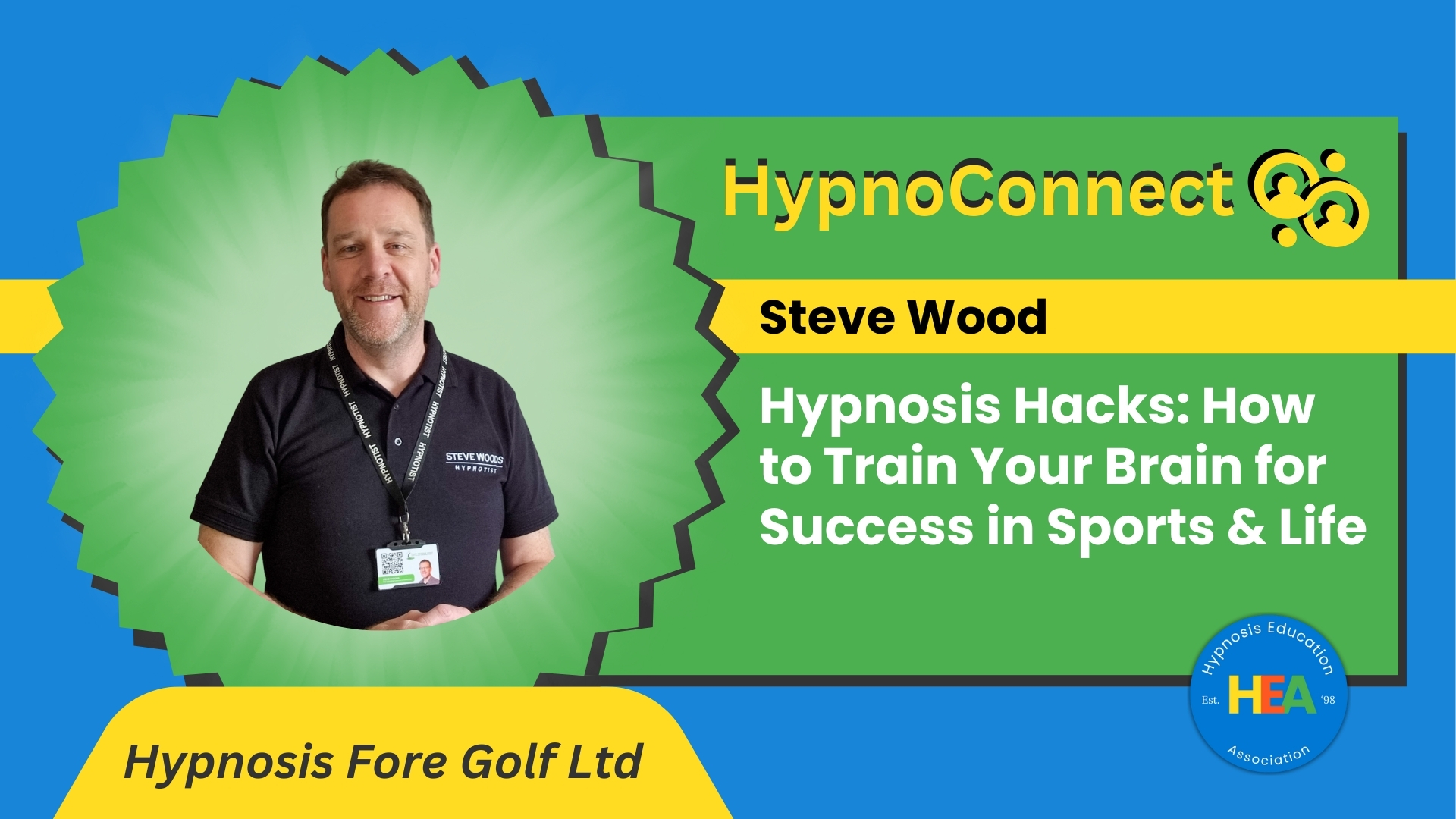
Steve Woods on Sports Hypnosis, the Zone, and Peak Performance
In an engaging Hypno Connect session hosted by the Hypnosis Education Association (HEA), Steve Woods shared how hypnosis can support athletes and performers who struggle with overthinking, confidence, focus, and consistency. Woods has practiced hypnosis for around 20 years and now specializes in golf hypnosis, while also applying performance techniques across other sports and professional settings. His presentation explored how hypnotists can help clients get out of their own way, access the "zone," create effective performance triggers, reset after each attempt, and measure meaningful progress. Whether you work with athletes or want to explore performance hypnosis as a new area of practice, register for Hypno Connect to learn directly from experienced hypnosis professionals.
or catch the podcast episode here.
From Hypnosis to Sports Performance
Woods' Path Into Golf Hypnosis
Woods began his hypnosis career around two decades ago and has worked in a wide range of environments, including workshops for medical professionals, charities, sleep programs, and sports performance.
Golf eventually became his primary niche.
He described performance hypnosis not as helping someone perform on a stage, but as helping people perform better by addressing the mental patterns that interfere with abilities they already possess.
For golfers, that often means reducing overthinking and allowing trained movements to happen more automatically.
When Golf Becomes a Mental Game
Woods' first significant golf client was a club captain struggling with the "shanks," where the ball travels sharply away from the intended direction.
Other golfers had become so concerned about seeing the problem that some would turn away because they feared developing it themselves.
For Woods, this immediately highlighted how strongly expectation and suggestion can influence sport.
Golf gives players plenty of time before each shot. That time can become an opportunity for the conscious mind to interfere with skills the body already knows how to perform.
Do You Need to Play the Sport Yourself?
The Athlete Is the Sport Expert
One of the most practical lessons from Woods' session was that a hypnotist does not need to be an expert golfer, boxer, racing driver, or athlete to work with performance clients.
The athlete already understands the technical side of their sport.
The hypnotist's role is different.
Woods encouraged practitioners to understand enough about the activity to communicate appropriately while staying focused on mindset, emotions, focus, and subconscious patterns. If you're weighing performance hypnosis as a new specialty, our guide on how to become a hypnotherapist walks through the training path.
As he explained, there only needs to be one expert in the room when it comes to the sport. The client can be the expert in golf while the practitioner brings expertise in hypnosis.
Speak the Client's Language
Some knowledge is still important.
Woods warned that using obviously incorrect terminology can quickly damage credibility. Golfers, for example, expect the practitioner to understand basic language around clubs, scoring, shots, and the flow of the game.
The same principle applies to any performance field.
Practitioners can research terminology, listen to relevant content, and most importantly ask clients how they describe what is happening.
During the discussion, the HEA hosts reinforced this idea: use the client's language rather than forcing your own terminology into their experience.
Creating Measurable Performance Goals
Track More Than Feelings
Woods emphasized the importance of measurable goals.
Golf makes this easier because players can track scores and handicaps. A client might want to break 90, reduce a handicap, or become a single-figure golfer.
These numbers create clear markers that allow practitioner and client to assess whether the work is making a difference.
Emotional Results Matter Too
Not every meaningful outcome is numerical.
A golfer might say that they regularly return home frustrated after playing and want instead to finish a round feeling relaxed, satisfied, or happy.
Woods encouraged practitioners to include these subjective outcomes alongside performance statistics.
Success may mean a lower score, but it can also mean enjoying the sport again.
Helping Athletes Get Into the Zone
What Is "The Zone"?
Athletes often describe the zone as a state where performance seems to happen without deliberate thought.
Woods described it as allowing the subconscious mind and existing muscle memory to take over.
Many clients have experienced this state without realizing it.
A golfer may remember making an excellent shot while casually talking with friends and only afterward realizing how well they performed.
The difficulty often begins when they consciously try to recreate it.
Woods summarized the difference simply: instead of trying to make it happen, the goal is to let it happen.
Recreate the Feeling
In hypnosis, Woods helps clients reconnect with what being in flow feels like.
Once that experience is established, the next goal is to create a reliable way to return to it during performance.
That is where triggers and anchors become useful.
Using Trigger Words for Performance
Keep the Trigger Simple
Woods often uses a simple word or short phrase as a trigger for entering the zone.
For golfers, words such as "smooth," "rhythm," or "tempo" may work because the sport depends heavily on fluid movement and routine.
However, Woods does not simply choose the word for the client.
The trigger needs to have meaning for that individual.
It should also be easy to remember and appropriate throughout the performance.
Connect the Trigger to the Routine
A golfer might prepare for a shot, take a practice swing, breathe in, and use the chosen word internally on the exhale before beginning the movement.
Woods sometimes adds a simple counting rhythm or metronome-like beat to occupy the conscious mind.
The goal is not to teach the physical movement.
The athlete has already practiced that movement hundreds or thousands of times.
The technique is designed to reduce conscious interference so the learned skill can happen naturally.
Visualization Is Useful, but It Is Not Everything
Work with the Client's Strongest Sense
Sports hypnosis often relies heavily on visualization, but Woods stressed that practitioners should not assume everyone experiences imagery in the same way. Our roundup of effective hypnosis methods covers how visualization is used across sports and business, but Woods' point is that it is only one tool among several.
Some people find mental images difficult or impossible.
Woods' work with blind golfers has strengthened this awareness.
Some clients have never had sight, while others lost their vision later in life and may have complicated emotions around visual imagery.
Use Sound, Feeling, and Other Sensory Cues
A golfer may recognize a strong shot through its sound, the feeling through the club, the rhythm of the movement, or the emotional response that follows.
These sensations can become part of the hypnosis process.
Woods encouraged hypnotists to think more broadly than simply repeating "visualize the shot."
The objective is to create an experience that fits the individual client.
The Power of the Reset
Leave Every Shot Behind
One of the strongest techniques Woods discussed was the reset.
Originally, he thought of resetting mainly after a poor shot.
Over time, he realized that a great shot can be just as distracting.
After performing extremely well, a player may start thinking about the final score, what other players will say, or what winning will mean.
Either positive or negative thinking can pull attention away from the present moment.
Woods therefore recommends resetting after every shot.
Play One Shot at a Time
The player is allowed to react naturally for a moment.
They can feel frustrated by a mistake or enjoy a strong performance.
Then they reset.
The previous shot is finished, and the next one begins fresh.
Woods described techniques such as mentally stepping out of a performance bubble before returning for the next attempt.
The exact reset does not matter as much as making it simple and consistent.
This principle also extends beyond sports. A public speaker who stumbles over a sentence, for example, can reset instead of allowing one mistake to affect the rest of the presentation.
"Try Not to Try"
Reduce the Pressure to Perform
Sports clients often arrive highly motivated.
They may have invested money, have an important competition coming up, and desperately want the hypnosis to work.
That determination can become another problem when the conscious mind begins monitoring every part of the process.
Woods frequently uses the phrase "try not to try."
He acknowledges that the client wants results, then encourages them to stop forcing the experience and simply participate. This mirrors the relaxed, letting-go state described in our guide to self-hypnosis techniques for deep relaxation.
Regular check-ins during the hypnosis session allow Woods to adjust if something is not resonating.
The goal is to create enough trust that the client can stop evaluating every moment and allow the process to unfold.
Performance Hypnosis Beyond Golf
Although golf is Woods' primary niche, many of the concepts apply to other activities.
He has used performance approaches with athletes in motorsport and other sports, while participants in the discussion shared examples involving boxing, swimming, gymnastics, baseball, BMX, dancing, and skating.
The details change, but the underlying themes remain similar: focus on what is happening mentally, understand the client's language, identify useful performance states, create triggers, reduce overthinking, and reset when attention shifts away from the task.
HEA's Community of Hypnosis Professionals
The Hypnosis Education Association brings practitioners together to explore different applications of hypnosis and learn how others are using their skills in real settings. Browse our member community to see the range of specialties HEA practitioners bring to the table.
Woods' presentation highlighted sports and performance hypnosis as an area that practitioners may not immediately consider when choosing a niche.
It also reinforced the importance of empathy.
For Woods, one of the most valuable skills a hypnotist can develop is the ability to step into another person's experience rather than rigidly following a script.
Join Hypno Connect: Explore Performance Hypnosis
Steve Woods' Hypno Connect session showed how hypnosis can help athletes move away from overthinking and toward more natural, focused performance.
His approach centers on keeping the process simple: understand the athlete's language, create measurable goals, reconnect with the zone, use meaningful triggers, work with the client's strongest senses, and reset after every performance moment.
The techniques may have been demonstrated through golf, but the underlying ideas can apply across sports, business performance, public speaking, and other areas where the mind can either support or interrupt learned skills.
To continue exploring practical hypnosis techniques and learn from professionals working across different specialties, register for the next Hypno Connect through the Hypnosis Education Association.
Frequently Asked Questions
What is sports hypnosis?
Sports hypnosis uses hypnotic techniques to support mental aspects of athletic performance such as focus, confidence, emotional control, consistency, and reducing overthinking. Steve Woods uses these approaches primarily with golfers but explains that many of the same principles can apply to other performance areas.
Do hypnotherapists need to play a sport to work with athletes?
No. Woods believes the athlete can remain the expert in the sport while the hypnotist focuses on mindset and performance. However, practitioners should learn enough terminology and context to understand the client and communicate credibly.
What does getting into the zone mean in sports hypnosis?
The zone is a state where performance feels natural and automatic without excessive conscious thought. Woods helps clients reconnect with that experience and uses triggers to make it easier to access during competition or practice.
How does a reset technique improve sports performance?
A reset helps an athlete mentally leave the previous performance moment behind and return attention to the present. Woods recommends resetting after both good and bad shots so the athlete does not become distracted by frustration, excitement, or thoughts about the final outcome.
What is Hypno Connect and how can I register?
Hypno Connect is an educational event hosted by the Hypnosis Education Association where hypnosis professionals share techniques, experiences, and practical applications from their specialties. You can join HEA to get access to upcoming sessions.


