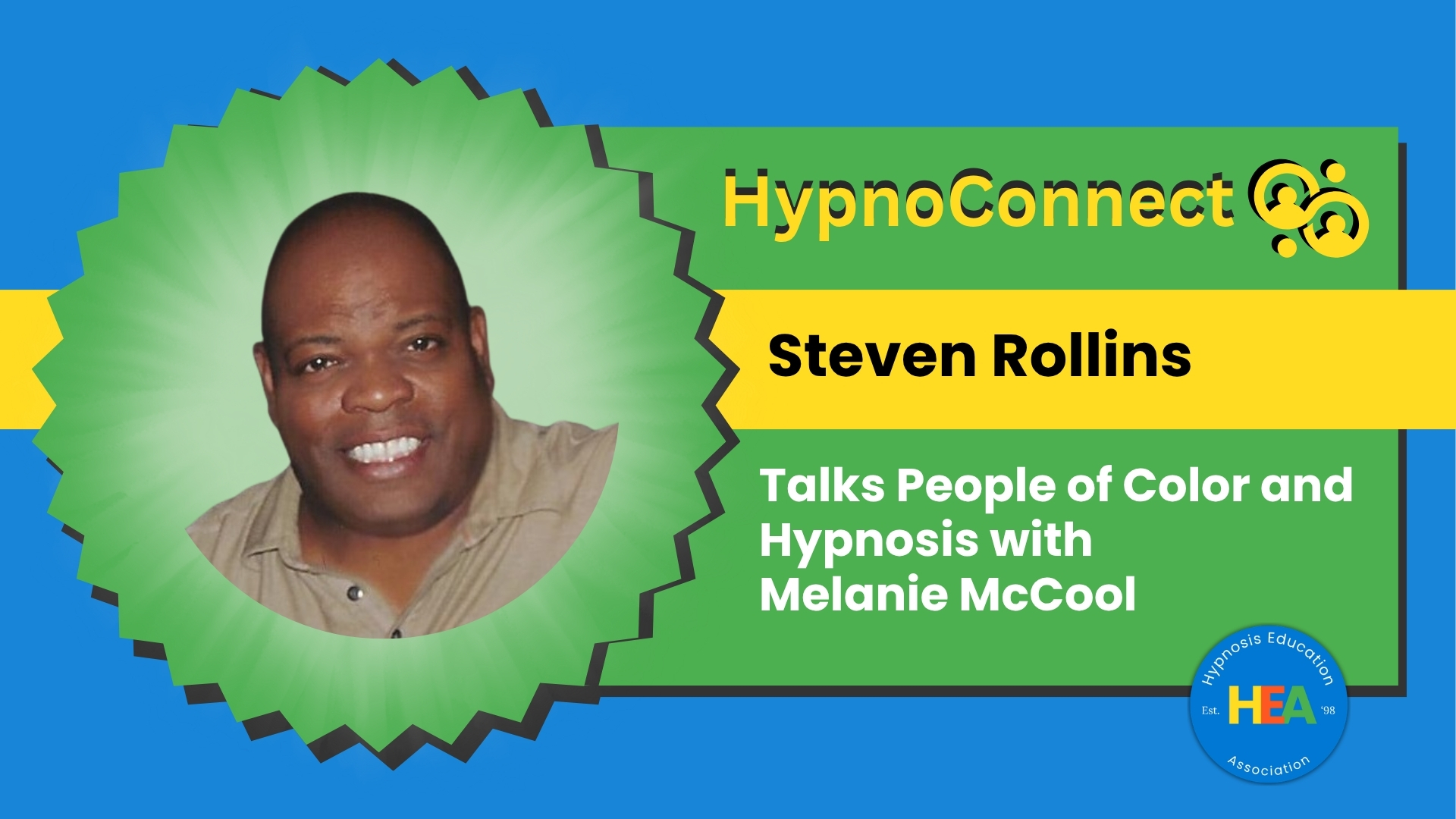
Steven Rollins on Why Hypnosis Still Struggles to Reach Communities of Color
Steven Rollins didn't set out to become a hypnotist. He set out to disprove it. A retiring Marine with a bachelor's degree in psychology, he sat in on a hypnosis class in 2006 on a dare, decided it was probably nonsense, and stayed after class to argue the point with the instructor instead.
Nearly two decades later, he's a Certified Hypnosis Instructor with the National Guild of Hypnotists and an ICBCH-approved instructor, running Explore Hypnosis in Manassas, Virginia, and teaching certification courses around the world, including a year spent training hypnotists in Saudi Arabia.
On this episode of HypnoConnect, Steven joins host Melanie McCool for a conversation he first started noticing on his own: at conference after conference, he kept looking around and asking, where is everybody who looks like me?
Watch the Full Session
Listen to the Podcast
Prefer to listen on the go?
LISTEN TO THE STEVEN ROLLINS EPISODE ON THE HYPNOCONNECT PODCAST →
Where Are All the Black Hypnotists?
Black Americans make up roughly 13% of the U.S. population, Steven says, but a much smaller share of that shows up at hypnosis conferences and training, typically somewhere around 4 to 5%.
So Steven did what any curious practitioner would do: he asked. He surveyed several Black-oriented groups with a combined membership in the thousands, asking a simple question: what would keep you from trying hypnosis? This episode is built around what came back.
Naming the Gap: POC and BIPOC
Steven opens with definitions, because the terms get used loosely.
POC ("people of color"): according to Steven, the term has been used for roughly 400 years to describe Black people specifically, only recently broadening to a wider meaning.
BIPOC (Black, Indigenous, and people of color): a newer term, gaining use over roughly the last decade, and more broadly inclusive.
For this conversation, Steven is using "POC" in its older, narrower sense, to talk specifically about the Black community and his own survey results.
What a Community Survey Revealed About Hypnosis
The reasons people gave for avoiding hypnosis clustered around a handful of themes, and Steven is careful to note none of them are exclusive to one community. He ran into nearly identical concerns while training hypnotists in Saudi Arabia, South Africa, and Eswatini.
"I Just Don't Know Anything About It"
The single most common response: people simply don't know what hypnosis is. What they do know comes largely from movies and stage shows, from finger snaps and mind control to the 2017 film Get Out, in which a hypnotist sends the lead character to a "sunken place" against his will.
Steven also points to something smaller but telling: bookstores and libraries often shelve hypnosis next to magic tricks and sleight of hand, rather than alongside psychology, reinforcing the idea that it isn't a serious therapeutic tool.
Practitioners who want to get better at explaining hypnosis in plain language can explore HEA's hypnosis education opportunities.
The Cost of Care Without Insurance
Steven notes that hypnosis sessions typically aren't covered by insurance, and for a community where money is often tight, that's a real barrier layered on top of not knowing whether it even works.
He contrasts a $25 insurance copay with the $100 to $400 many hypnotists charge per session, a gap that has to feel worth crossing before someone will try.
When Faith and Hypnosis Feel at Odds
Religious objections came up as one of the strongest themes in Steven's survey, particularly among Christians who see hypnosis as conflicting with their faith.
Steven doesn't try to argue anyone out of a religious concern. Instead, he's found that a plain, non-salesy explanation of what hypnosis actually is, and everyday examples of trance most people already recognize, tends to open the door on its own.
He draws a direct comparison to his year in Saudi Arabia, where, as he describes it, a fatwa once treated hypnosis as invoking an "evil jinn," and a newer ruling now permits it, as long as no jinn is involved and the intent is to help.
Fear of Losing Control
A recurring worry: that a hypnotist can make a client do anything, including things they'd never choose for themselves. Steven traces this directly back to stage hypnosis imagery, the idea that a session means being made to "bark like a dog" for an audience, rather than working toward a client's own goal.
"That's White People Stuff"
Steven also heard a subtler barrier: the sense that hypnosis, like much of the broader personal-development and self-improvement world, is something reserved for people with the financial cushion and cultural permission to pursue it.
He ties this to history rather than preference. Without reliable access to a family doctor, psychologist, or psychiatrist for generations, prayer became the default coping mechanism in many Black households, and that default is hard to displace.
Building Trust Across Cultures
The second half of the conversation turns to what practitioners can actually do about all of this, starting with a shift in posture: show up consistently, not just once a year with something to sell.
Go Where the Community Already Is
Steven's clearest advice: find where a community already gathers, rather than waiting for it to come to a hypnosis conference.
For him, that's meant presenting at BlerdCon, the Washington, D.C.-area Black Nerd Convention, where a hypnosis 101 talk regularly draws a packed room, even at an event built around anime and comics rather than health.
Ask What the Community Needs From You
Rather than arriving with a pitch, Steven recommends opening a conversation: introduce yourself as a hypnotist, and ask what services would actually be useful. Letting the community set the agenda, he says, does more for rapport than any amount of self-promotion.
Advertise Inclusion Openly, Without Overplaying It
On a practice's own marketing, Steven suggests stating inclusivity plainly: a zero-tolerance stance on racism, sexism, and bias, visible on the website, and making sure people of color are actually visible in a practice's or an event's own marketing images.
He also flags a common misstep: saying "I don't see color" lands as dismissive, not welcoming. The goal isn't blindness to identity, but full acknowledgment of it.
Being an Ally vs. Being a Co-Conspirator
Steven draws a distinction worth sitting with:
An ally speaks up when something is wrong in the moment, refusing to let a biased comment pass unchallenged.
A co-conspirator goes further, willing to make the case for a group's perspective even when no one from that group is in the room.
Being either, he says, takes real effort to understand a client's or community's lived experience rather than assuming it.
A Faster Cultural Shift Than Anyone Expected
Steven closes with an observation from his year in Saudi Arabia, where he watched enormous social change unfold in roughly seven years, changes he attributes to education, access to information, and access to mental health care.
He contrasts it with parts of the American South that remain segregated to this day, and argues that the same three ingredients, especially access to hypnosis and mental health support during a period of change, could accelerate trust-building here too. He's especially encouraged by what he sees in hypnosis clients and attendees under 40, a generation he describes as "wide open" to the work.
Key Takeaways for Practitioners
Most resistance to hypnosis starts with simply not knowing what it is, not outright rejection.
Cost and lack of insurance coverage are real, practical barriers, not just attitude problems.
Religious objections deserve respect, not argument; plain education tends to do more than persuasion.
Showing up consistently at community events builds more trust than annual outreach ever will.
"I don't see color" reads as dismissive; acknowledging identity openly reads as welcoming.
Being an ally means speaking up in the moment; being a co-conspirator means advocating even when no one's watching.
Open, practical conversations like this one are a big part of why practitioners join the HEA community.
Join the Next Hypno Connect
Want more conversations like this one? Register for the next live HypnoConnect session, and see the full lineup at our upcoming conferences and events.
Frequently Asked Questions
What does "POC" mean in this conversation?
Steven uses "POC" (people of color) in its longer-standing sense, referring specifically to the Black community and the results of his own community survey, while noting the term has broadened over time.
Why are people of color underrepresented in hypnosis, both as clients and as practitioners?
Steven's survey points to a mix of factors: limited awareness of what hypnosis actually is, the cost of sessions without insurance coverage, genuine religious concerns, and a fear of losing control, layered on top of a broader unfamiliarity with therapy and mental health support generally.
Do I need to share a client's cultural background to help them effectively?
No. Steven argues that empathy and curiosity, taking the time to genuinely understand a client's perspective, matter more than a shared background. He points to his own work with clients from cultures very different from his own.
How can hypnotists reach communities that don't know much about hypnosis?
Steven's approach is to show up consistently at community events, offer a plain-language "hypnosis 101" talk, and ask the community directly what it needs, rather than arriving with a sales pitch.
What's the difference between being an ally and a co-conspirator?
An ally speaks up against bias in the moment. A co-conspirator goes further, advocating for a group's perspective even in that group's absence.
Where can I learn more about these issues outside of HypnoConnect?
Steven recommends the documentary 13th (Ava DuVernay), Chelsea Handler's Hello, Privilege. It's Me, Chelsea, and Emmanuel Acho's Uncomfortable Conversations with a Black Man.


